
Artificial intelligence has moved on from just being a word of the future to being implemented in every facet of business operations. According to a McKinsey & Company1 2025 report, 78% of organizations are now using AI in some form, from automating communications to internal queries. Organizations are beginning to reshape their workflows as they deploy gen AI.
But as the sheer volume of AI tools increases tenfold, IT leaders face a critical choice: how do you keep up, test every solution, and ensure you’re using the best tool for the job without risking the exposure of confidential information? Unmanaged AI sprawl isn’t just inefficient—it’s a major security and compliance liability. In the worst-case scenario, the wrong AI tool could be chosen that risks exposing confidential information.
So, how do you capture the benefits of AI while containing the risks in a secure, compartmentalized solution?
It might sound too good to be true, but at Beam Data, we’re proud to share that a solution already exists for enterprises ready to harness the full power of AI: the AI Hub.
In this blog, we’ll break down the essentials — what an AI Hub is, what you can expect from it, its benefits, and more. So let’s dive in.
What exactly is an Enterprise AI Hub?
So, what does an AI Hub for enterprise mean? Just like an ERP system centralizes the operations; CRMs centralize the customer intelligence, an AI enterprise hub aims to centralize all of a company’s AI initiatives. Beam Data’s AI hub for enterprises team is meant to serve as a unified platform for organizations. It’s where data, pipelines, models governance and workflows are combined to work seamlessly together. Instead of creating silos of AI pilots for every function (marketing, finance, & more), an enterprise gets a single, secured environment where their employees can use AI at scale responsibly and consistently.
Why will Enterprise AI hubs for businesses be inevitable?
AI hubs at first seems like a foreign concept, and you might wonder what are the reasons to adopt it in the first place but there are several reasons why AI hubs experience an increase in adoption:
- Elevated Pace Model Change
The pace of model innovation is accelerating. Foundation models are evolving very quickly. Take Google’s Gemini model, there is a release of a new model every 3 months. With such strong innovation change, enterprises can’t afford vendor lock in. They need infrastructure such that it allows them to apply, swap, and fine-tune their models.
- Regulations
Another reason why AI hubs will become more prevalent are due to stricter regulations like EU AI Act. EU AI act and other such regulations demand transparency, audits, robust systems of governance. A hub makes this compliance enforceable at scale. Beam Data’s Business Hub gives companies a fully secure, governed on-premise or private-cloud environment for deploying enterprise LLMs and multi-agent AI systems at scale.
- Costs
Fragmented AI initiatives lead to duplication of efforts and ballooning shadow IT costs. A centralized hub eliminates this waste and, more importantly, provides the single platform needed to track AI usage, measure its impact, and accelerate measurable Return on Investment (ROI)
- Consistency Across Hybrid Environments:
Enterprises operate across a complex mix of private, public, and on-prem cloud solutions. A well-designed AI Hub provides a single, consistent, and unifying layer, ensuring that your AI strategy works seamlessly and securely regardless of where your data or infrastructure resides.
Key Advantages of an AI Hub for Enterprises
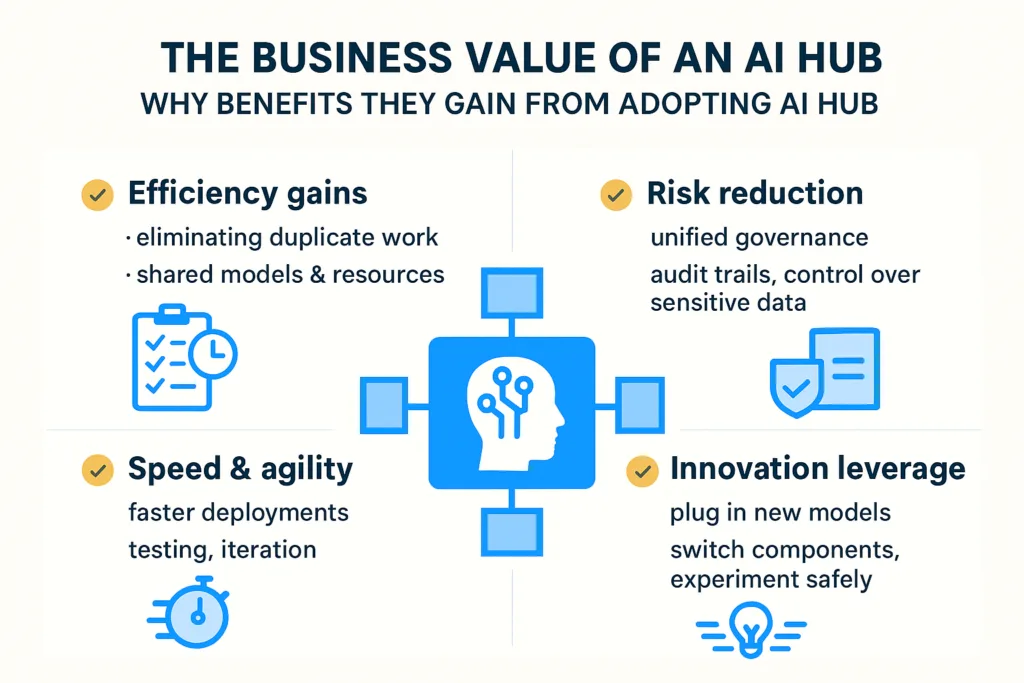
The benefits of adopting an AI hub are:
- Centralized Collaboration & Resource Sharing
AI hubs provide a central workspace for data science teams to share resources, execute workflows, and collaborate on projects, regardless of their technical expertise.
- Standardized Development & Governance
They offer consistent tools and standardized MLOps pipelines, ensuring compliance and governance while accelerating the transformation of data into actionable insights.
- Accelerated Time-to-Market
By simplifying deployment and offering pre-validated applications and templates, AI hubs help enterprises quickly bring AI-driven products and solutions to market.
- Scalability & Flexibility
Hubs are scalable, allowing enterprises to pay for what they need and grow as they go. They also provide access to a variety of LLMs and technologies, allowing for seamless integration and customization.
- Improved Efficiency & Automation
AI hubs automate routine tasks, optimize operations, and improve the accuracy of business processes, leading to increased workforce productivity and operational efficiency.
- Access to Advanced Technologies
Enterprises gain access to cutting-edge technologies like Retrieval Augmented Generation (RAG), advanced video analytics, and Large Language Models (LLMs), enabling sophisticated AI applications.
- Secure Data Management
Rigorous security protocols protect sensitive enterprise data, ensuring that data is only accessible to authorized personnel and is stored according to specific requirements.
- Integration & Interoperability
AI hubs facilitate the integration of pre-trained models, applications, and frameworks from various partners, creating a cohesive and powerful AI ecosystem
Common Use Cases of AI Hub
Now that you have understood the mechanics of an AI Hub, you might wonder, how will an AI hub fit into the business model? So, AI enterprise use cases are diverse, ranging from improving customer service with chatbots and personalizing marketing campaigns to optimizing supply chains and enhancing cybersecurity. AI hub can help as focal point in functions like:
1. Marketing & Customer Service
- Personalized Marketing: Analyze customer data to create tailored marketing campaigns and product recommendations.
- Content Generation: Automate the creation of marketing copy, product descriptions, and ad campaigns.
2. Human Resources & Recruiting
- Resume Screening: Assist in screening resumes and matching candidates to open positions, streamlining the hiring process.
- HR Onboarding: Facilitate the onboarding process for new hires by automating administrative tasks.
3. Finance & Security
- Fraud Detection: Analyze transaction patterns to identify and flag fraudulent activities, significantly reducing financial risk.
- Cybersecurity: Detects and mitigate cybersecurity threats by identifying and responding to anomalies in network activity.
4. Operations & IT
- Process Automation: Automate repetitive tasks like data entry, software testing, and updating systems of record.
- IT Support: Handle routine IT tasks, provide self-service options for employees, and categorize support tickets to reduce IT workload.
Enterprise AI implementation challenges
Some of the common challenges are:
- Integration with legacy systems still poses hurdles.
- Data quality and harmonization remain critical bottlenecks.
- Governance and transparency must be embedded early.
- Change management is essential: employees need trust and training.
- Design the hub’s architecture to ensure scalability and cost control.
A Glimpse at Tomorrow with AI Enterprise Hub
Picture your organization in 2026.
Employees don’t hunt for AI tools; they access them through a single secure portal. Sensitive data never leaves approved environments. Executives view real-time dashboards that show not only how AI is being used, but how much value it’s creating. AI copilots aren’t shadow projects; they’re seamlessly embedded in workflows, approved by compliance, and delivering measurable ROI. And this is what Beam Data wants to achieve. Beam Data’s Enterprise AI Hub solution is a secure, unified enterprise AI platform for private LLM deployment, multi-agent workflows, and governed retrieval — deployable fully on-prem or in your private cloud keeping confidential information within your own organization.
Now picture the alternative: fragmented pilots, ballooning costs, and regulatory headaches. That’s the gap between enterprises with an AI Hub and those without. You can choose to change your reality anytime.
Grow with Beam Data
The organizations that will act now will shape the future of the intelligent business landscape and acquire the first mover advantage. With waiting out decisions, companies will continue to be bogged down in fragmented processes and tools, exposed to compliance risks and competing with enterprises who are already installing AI processes. Every enterprise needs AI hub by 2026. By 2026 AI hubs will be the operating backbone of every modern business. The cost of inaction can be very heavy. And your competition is not waiting.
If you are a senior leader ready to future proof your organization, Beam AI Hub is designed for scale, governance and real impact. Contact us today
to learn how Beam can help you build your AI Hub and lead — not follow — the AI transformation.
Frequently Asked Questions (FAQ)
1. What is an AI Hub?
An AI Hub is a centralized platform for managing data, models, governance, and deployment in a secure environment. Beam Data, a North American AI Hub solutions provider, helps enterprises build customized, compliant, and secure AI Hubs designed to meet everyday business needs.
2. How can AI Hub be used in a business?
AI can be used in a business to automate workflows, enhance decision-making, personalize customer experiences and more With the right hub, these use cases can scale securely across departments.
3. How do you deploy AI on-prem securely?
You deploy AI on-prem by running models inside your own controlled environment with strict access, encryption, and governance. Beam Data’s AI Hub lets enterprises deploy LLMs fully on-prem or in a private cloud, ensuring data never leaves their secure boundary.
4. What is a multi-agent system in enterprise workflows?
A multi-agent system uses multiple specialized AI agents that work together to complete complex business tasks. Beam Data’s AI Hub provides a unified orchestration layer, allowing teams to build, manage, and govern multi-agent workflows in one place.
5. How do you govern LLMs inside a company?
You govern LLMs by centralizing permissions, monitoring usage, enforcing policies, and auditing data access. Beam Data’s AI Hub for companies teams offers built-in governance, giving enterprises a single platform to control all models, agents, and AI workflows.
6. How do I use AI Hub for my business & Who do I contact?
To use AI for your business effectively, start by identifying high-impact use cases, ensuring data quality, and establishing governance. From there, build a scalable strategy using an AI Hub to manage and deploy models securely. If you would like to start using AI hub for your own business today, contact Beam Data today.
Sources & References
- McKinsey & Company (QuantumBlack), “The State of AI in 2025: Agents, Innovation, and Transformation,” November 5, 2025, https://www.mckinsey.com/capabilities/quantumblack/our-insights/the-state-of-ai ↩︎