
With news of AI being superlaunched into every faucet in the business function, there is a ground reality that cannot be ignored. Corporate AI projects are failing to deliver impactful value to stakeholders. To preface, MIT recently reported that 95% of generative AI projects are not delivering significant value. This is an alarming rate of dejection of AI in the workplace where it is meant to deliver significant value and growth potential so where is it all going wrong? Was AI a dream that has failed with its conception? The issue is deeper than that.
In this blog, we will explain what constitutes a failed AI project, explore common reasons why AI projects stall, and provide guidance on how to navigate these challenges to ensure a successful pilot within your organization.
What Defines a Failed AI Project
AI budget failure does not always look like a cancelled project.
More often, it looks like:
- Multiple pilots that never scale
- Tools that work in isolation but not together
- Growing infrastructure costs with unclear ROI
- Inconsistent or untrusted AI outputs
- Compliance and security risks discovered too late
Examples of Corporate AI failed projects
Some of the common AI projects that failed terribly were: Google flu trends1 that were aimed to predict how the flu would grow and expand but it failed due to overreliance on search data without validation. Another example is Microsoft’s Tay chatbot,2 designed to learn from user interactions, but it began generating offensive language and was subsequently taken offline.
Common Reasons Enterprise AI Projects Stall
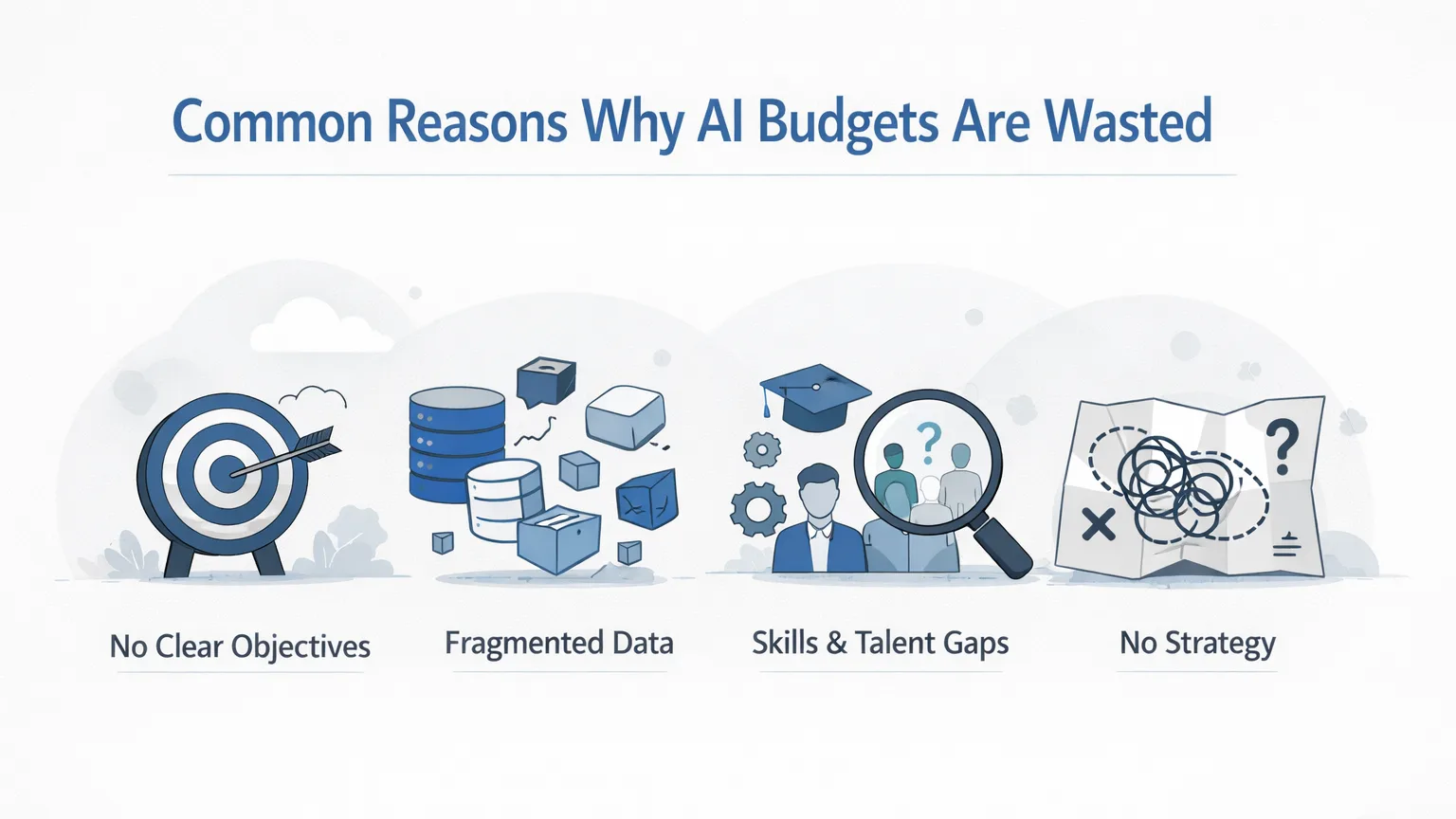
According to S&P Global Market Intelligence’s 2025 survey of over 1,000 enterprises across North America and Europe, 42% of companies abandoned most of their AI initiatives this year, a dramatic spike from just 17% in 2024. This failure of adoption tends to stem from larger issues such as:
- Unrealistic expectations of companies
With AI becoming a “buzzword”, investors are open to jump at any opportunity to uplift their organizations with AI but the key point here is to understand that: does AI even fit into their business model? Enterprises need to take off their rose tinted glasses and understand the benefits and limits of an AI solution rather than seeing AI as a “one size fits all” problem solution.
- Lack of business use cases
Companies often struggle to identify a strong or viable application for AI within their systems. Advancing AI initiatives without thorough research can backfire, leading to significant financial losses and unmet expectations.
- Misalignment with current workflows
Another common reason why businesses may see a failing AI project is because the current AI pilot might not fit within the current workflow or the end user e.g. the customer might not gel well with the AI system if they do not deem it as “trustworthy” in their decision making process.
- Data and Infrastructure Challenges
The most common issue a company can face when integrating AI within their system is that they do not have enough or well documented data systems in place that the AI could benefit from. For example, if a company relies heavily on legacy systems that lack compatibility with AI, integrating AI becomes a major challenge. In some cases, this obstacle is so overwhelming that the AI project is ultimately abandoned.
- Data Integration Gaps
Oftentimes, company functions and teams operate in separate silos, limiting the overlap and sharing of information. This makes it difficult to collect, clean and streamline the necessary data required to set up an AI pilot for the organization.
- Data Privacy and Compliance Concerns
Navigating data privacy and compliance concerns pertaining to policies like GDPR, EU AI act, and more can slow down the process of adoption of an AI system. If these issues are not addressed, they can create legal and regulatory problems for the company in the long run.
- Skills Gap
Another common reason why AI might not perform that well in an organisation is the “unawareness” of what an artificial intelligence model could do for the company. Employees may lack the skills to understand, apply, and integrate AI models into their traditional workflows, leading them to avoid using the technology to prevent mistakes. Providing AI upskilling training helps employees understand how AI supports their daily tasks, fostering greater acceptance. With a clear understanding of AI’s benefits, employees can apply AI models more effectively in suitable areas and explore new use cases tailored to their specific needs.
Aftermath of a failed Corporate AI project on the organization
A failed project can have the following consequences on the organization:
- Financial Loss
The most significant and visible loss a company faces when a corporate AI projects failing is the financial investment in the project. This investment also carries an opportunity cost. As the funds could have been allocated to other initiatives such as expansion or equipment upgrades.
- Operational Disruption
Labor pivoted towards the AI project could have used their time at a more productive project that could have generated gains for the company. With the failure of the project, this would in turn could downgrade the employee morale.
- Compliance and Legal Issues
If the project involved dealing with sensitive data, there might be legal and regulatory scrutiny.
How should an organization aim to achieve an successful AI project
To prevent projects from being scaled back into less ambitious versions, follow these key recommendations:
- Solve a real business problem before jumping into AI
Try to find a real problem your organization is currently facing. See the types of problems: are they recurrent? Is an AI solution a feasible solution for this problem? McKinsey’s 2025 AI survey confirms this pattern: organizations reporting “significant” financial returns are twice as likely to have redesigned end-to-end workflows before selecting modeling techniques.
- Keep a human in the loop
To ensure cohesiveness and uphold a system of checks and balances, include a human in the loop. For example, a human can verify the credibility of information before a post goes live.
- Set Confidence thresholds
Set benchmarks and escalation paths to see what a successful AI project would look like and perform in the user specific setting. Scenarios in cases if it does not perform its intended purpose.
How can Leadership help AI adoption in their own organizations
Individuals in leadership roles can also help AI adoption process by:
- Leaders should ensure that the core expertise team (technical team) understands the project and domain context. Any miscommunication between any party could result in an ineffective solution
- AI projects require significant time and effort, so leaders should prepare themselves and their teams for the commitment involved and avoid rushing projects in pursuit of quick success.
- Leaders should be open to investing in infrastructure. Many companies, such as banks, remain tied to their legacy systems for several reasons, including cost, convenience, and familiarity. But it is necessary to understand that any AI project might involve system upgrades to work correctly.
- Leaders should also understand AI limitations. As AI has its own benefits, it carries its own set of drawbacks. It is necessary for leaders spearheading the project to understand that AI might not be efficient to solve every problem
How Beam Data can help organizations avoid an AI failure
In conclusion it can be seen that as corporate AI projects failing has its moments of downturn, it is necessary to learn and understand why it may not perform that way it is intended. Beam Data supports enterprises in organizing, identifying, and strategizing their AI initiatives by providing a structured foundation for AI adoption like AI hub. Rather than adding to tool sprawl, Beam helps organizations assess their current AI footprint, align AI use cases to business objectives, and establish the governance and orchestration needed to scale responsibly. By bringing clarity to models, Beam enables companies to move from fragmented AI experimentation to confident, business-led AI execution. If you are ready to supercharge your AI project progress, contact us today.
FAQs
1. Why do AI projects fail despite modern tools?
Mostly corporate AI projects failing due to fragmented tools, siloed data, and lack of governance or scalable processes.
2. What is the financial impact of a failed AI project?
It wastes budget, duplicates effort, and slows innovation while increasing risk.
3. How can enterprises prevent AI budget waste?
Centralize AI management, align initiatives to business goals, and implement governance.
4. How can Beam Data help organizations succeed with AI?
Beam provides AI Hub and customized solutions to organize, govern, and scale AI effectively.
Sources & References
- James Vincent, “Twitter taught Microsoft’s AI chatbot to be a racist asshole in less than a day,” The Verge, March 24, 2016, https://www.theverge.com/2016/3/24/11297050/tay-microsoft-chatbot-racist. ↩︎
- David Lazer and Ryan Kennedy, “What We Can Learn From the Epic Failure of Google Flu Trends,” WIRED, October 1, 2015, https://www.wired.com/2015/10/can-learn-epic-failure-google-flu-trends/. ↩︎