
Business enterprises generate a significant amount of information daily, including processes, documents, and data shared across teams. Due to time constraints, rules and information are sometimes distributed informally, which can result in them going undocumented.
When information is scattered, it often results in teams finding the same information over again with key decisions being delayed. With medium enterprises creating information from 10 gigabytes weekly, this leads to the question of how one captures this knowledge in the workplace into one instance where it’s accessible to whomever it needs without going through endless amounts of documents for one single piece of information. Or pinging every other engineer/manager for a quick chat.
Adding Artificial Intelligence into the enterprise mix, has started to change how knowledge is created, secured and shared in the AI Workplace. The emerging generation of enterprises will be relying on AI systems for information management systems like Beam Data’s AI Hub to accumulate such efforts into one unit.
What is Knowledge Sharing in Enterprise?
Before we can dive in, we need to understand what knowledge sharing means, why is knowledge sharing so important & why should your employees be an active part of it. According to Docebo, Knowledge sharing can be defined as sharing of information and expertise from one group to another. It is not only receiving information but also giving information, from experiences, data to documents, from other parties. Information can be decoded into two crucial parts in a business ecosystem:
- Tacit Knowledge
Tacit Knowledge involves beliefs, values, & experiences that are hard to document as they are invested within an individual. So the best way to document is by engaging in collaborative work and deep conversation with team members.
- Explicit Knowledge
Explicit knowledge is easier to share among team members as it’s what they are actively doing: creating documents. Good examples of explicit knowledge are SOPs, documents, manuals & guidelines that are more straightforward to read and understand.
Why is it important that knowledge sharing remains an active part of your enterprise? Over time, employees acquire new skills and knowledge through various methods. They can also extract valuable insights from this knowledge. Businesses actively manage knowledge through knowledge management practices to prevent its loss and ensure it can be referenced for future business transactions.
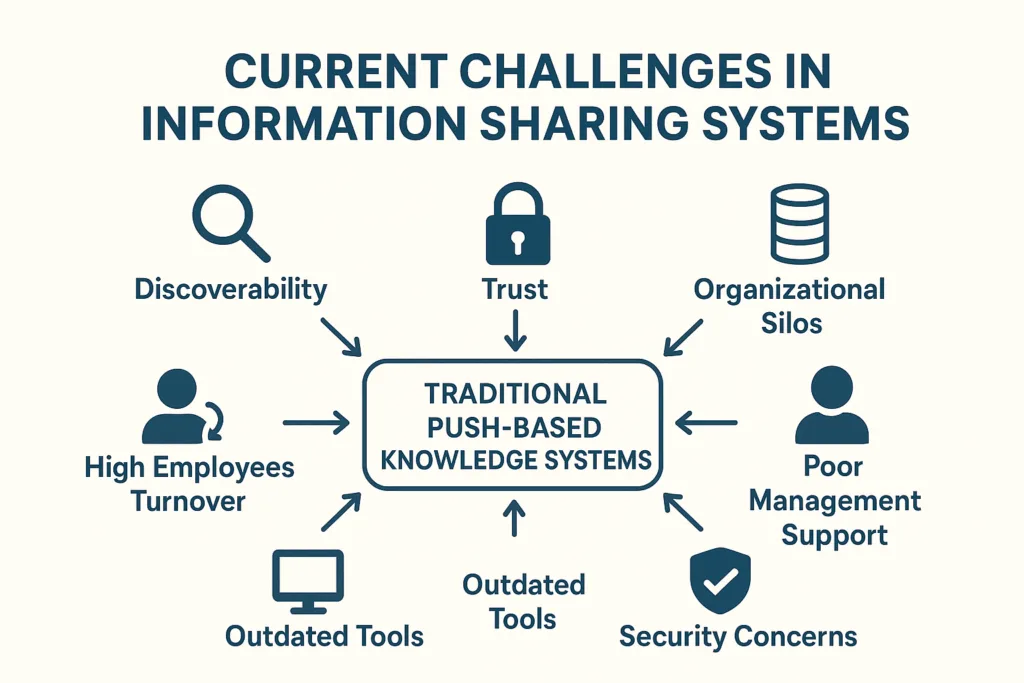
Current Challenges in Information Sharing Systems
Traditional Knowledge management based systems is a push based system as it heavily relies on wikis, intranets storing information in one place. However there were issues within this push based model:
- Discoverability
Employees struggled to find relevant information among heaps of information. Even in documented details, one needs a strong understanding of the knowledge documentation to find what they are looking for. Some examples of questions at this stage by employees could be: “How do I respond to an X ticket” or “What was the guideline for submission”
- Trust
As documents age, employees may doubt the accuracy and credibility of the information they contain.
- Organizational Silos
Rigid departments often disrupt the free flow of information across other departments leading asymmetric information distribution
- Poor Management Support
With a weak leadership in place, employees may not be motivated enough to document tacit and explicit knowledge. It is also possible that there is no strong incentive or reward system for employees who take part in knowledge sharing
- High Employees Turnover
High employee turnover can result in the loss of credible and valuable information, forcing organizations to retrain new employees for the same objectives and increasing training costs.
- Outdated Tools
Tools like wikis,emails are not meant for dynamic collaboration among team members leading to fragmentation of information
- Security Concerns
Some Employees may not share information as they may doubt the security of the system and might be averse to risking sensitive information regarding the business.
Beam Data’s AI Hub Features in Knowledge Management Systems
The following are key features of an AI hub:
- AI Powered Search
Finding information rooted in a company knowledge base can be a frustrating task if you are not equipped with the right keywords and folders. With Beam’s AI Hub, AI powered search aims to solve this issue by combining natural language processing methods. For example if an employee searches for the refund policy for the latest refund, it will automatically fetch the latest information and required conditions for the refund to be successful at both ends. Also AI powered search can be helpful in retrieving information without any blockers & delays as all valuable information is in one place.
- Intelligent Search
With AI hub into the mix, 2 pivotal experiences are generated:
- Conversational search: Users can ask questions in natural language and AI understands the meaning behind the words and provides contextually relevant answers rather than just giving matched results
- Personalized results: AI considers the person’s role, history and preferences in refining the search and delivering the right information to the right person.
- AI Assisted Content Authoring
In every enterprise, every team has its own approach to setting up the documents, next steps and policies. A data heavy team may approach and structure their documents differently than a content heavy team. This difference in their approaches makes it difficult for employees to relay and understand each other’s share of information correctly. This in turn also makes applying this information difficult.
With AI assisted content authoring, it can help users create and manage content in real time. It reviews an employee’s draft and understanding to ensure the document accurately reflects its content. This ensures that when the draft goes to a third party, it represents the business model’s policies correctly and avoids contradictions between what is communicated and what both parties expect. Another example of this can be, it can help an employee navigate the technical documentation to troubleshoot an error as AI can help break down the next steps in easy guidelines.
- Smart Knowledge Summaries
Smart Knowledge Summaries can help find the right information in a company’s knowledge base. In a fast-paced environment that demands quick answers, the smart knowledge summary feature instantly and accurately answers employees’ questions using verified documents.
Generative AI can simplify document content and provide links to its source, allowing employees to quickly locate the original information. For example, if an employee searches for payment deadlines and conditions, this AI enterprise hub feature delivers instant results.
- AI Powered Document Ingestion
With an enterprise’s information scattered across various document types, from Word to PDF, opening each document to find quick answers can become cumbersome. AI powered documentation ingestion helps fix this by turning unstructured documents into easy to read, searchable documents for the user. In this way, knowledge discovery becomes easy. With AI, the uploaded documents can be broken down into key topics, and arranged neatly. It also helps remove the doomless scrolling to just find the right section of information. E.g. It can help an employee go through the Employee Conduct Book without endless scrolling for “Leave Policies”.
- Integration
Beam Data’s AI Hub can be seamlessly integrated with other business and project management tools to streamline workflows. It also helps in compliance monitoring by ensuring that knowledge management systems comply with ethical and regulatory standards. In this way, sensitive information is locked within the enterprise.
Beam Data’s AI Hub Benefits in Knowledge Management Systems (KMS)
The Beam Data AI Hub benefits for KMS are:
- Automation of Routine tasks
AI automates many time consuming tasks associated with knowledge management, including basic queries regarding human resources leading to focus more on strategic work. The AI hub chatbot can generate quick answers for reports and even create basic reports, enabling teams to move forward with the next steps. This automation reduces human errors and ensures knowledge management maintains its reliability.
- Improved decision making
AI can analyze historical data, current market trends and external factors to deliver predictive insights to aid decision making for stakeholders. It can provide quick access to relevant information and generate data driven insights that can lead to more informed strategies. It can help create the vision of how different choices & outcomes will look like for the company. With this stimulation, it can also help graph the knowledge gaps present within the enterprise and how they can bridge the gap in those areas.
- Content Management
Additionally AI automatically organizes, tags and updates content in the knowledge management base so it remains accurate and well structured. With AI Hub, generative AI features can help create new, summarize and draft reports and presentations. By relying on internal documents, AI powered results ensure that all employees across the organization have access to the same information.
- Scalability
AI powered systems can accommodate data growth without performance degradation. This also reduces the costs by improving efficiency by automating tasks and reducing reliance on manual labor.
Beam Data’s AI Hub Use Cases in Knowledge Management Systems (KMS)
Knowledge management can be crucial with high confidential organizations such as healthcare, pharmaceutical, financial and education for further assistance without risk to third party exposure. To elaborate on more:
1. Healthcare & Pharmaceutical
AI hubs in healthcare and pharmaceutical companies can serve to enhance operational and research functions by:
- Medical Research and Summarization
The AI hub can help process, interpret and summarize massive amounts of medical research papers, enabling researchers to stay up to date.
- Workflow Automation & Resource Management
AI hub can help automatize hospitals day to day workflows like scheduling, billing and common queries by employees. It frees up resources and redirects them to more productive areas.
- Staff training and faster onboarding
The AI hub’s knowledge management functions centralize and automate guidance through training materials and conversational chatbots, enabling new hires to adapt to the company’s culture. It also redirects to the correct contact in case of urgency.
2. Education
AI based Knowledge Management tools help in education by:
- Improved Student Motivation
A research study1 conducted on the use of AI based knowledge management tools found that AI-based KM tools help HEIs (Higher Education Institutions) adapt better to global changes and improve remote learning and student motivation.
- Personalized learning paths
AI hubs can help teachers analyze various student performance data and learning styles to recommend tailored lessons, resources and exercises allowing students to to learn according to their strengths and weaknesses.
3. Financial Services
Key use cases of AI hub in financial services includes:
- Intelligent Chatbots
AI hub conversational chatbots provide 24/7 support to handle routine inquiries by employees. It can also offer financial advice freeing up human agents for more complex issues.
- Document Processing and Automation
The Beam Data AI hub can help automate repetitive back office tasks such as report generation and streamline workflows. This will reduce your organization’s operational costs.
AI Hub Knowledge management Challenges
With AI hub KM tools comes great responsibility. These new opportunities always bring challenges that organizations must address. Some of the challenges of adopting an AI Hub Knowledge management system can depend on the: technological and human challenges. Technological challenges can include the lack of uniform data quality standards, limited ability to scale and maintain systems, and the persistence of knowledge silos. Human challenges can include employee resistance, often driven by fears that AI may take over parts of their jobs or ultimately replace them.
Customize your AI Hub with BeamData
Knowledge is one of a company’s most important assets, so organizations must store and use it in an accessible manner. For this reason, BeamData commits to helping organizations own their knowledge management systems. BeamData’s AI hub is the perfect solution for directors and managers looking for a customized yet seamless integration to your team to help enable secure context aware conversations and decision making across the organization.
Ready to see how Beam Data’s AI Hub can transform your enterprise knowledge management systems? Contact us today.
FAQs
1. What is an AI Hub for enterprise knowledge sharing?
An AI Hub is a centralized platform that connects all organizational knowledge sources and uses AI to make information discoverable, secure, and actionable.
2. How can AI improve knowledge sharing in an enterprise?
AI enables semantic search, summarization, and proactive recommendations, helping employees find relevant information instantly and reducing duplication of effort.
3. How does an AI Hub protect sensitive enterprise data?
AI Hubs use role-based access control, encryption, and internal deployment to ensure sensitive knowledge never leaves your organization.
4. What are the business benefits of using an Beam Data’s AI Hub?
Faster decision-making, improved collaboration, reduced onboarding time, and a single source of truth across the enterprise.
5. What role will AI Hubs play in the future of enterprise collaboration?
AI Hubs will form the backbone of intelligent workplaces — where knowledge flows securely, contextually, and continuously across teams.
Sources & References
- Haftom Gebregziabher, Exploring the Impact of AI-based Knowledge Management Tools in Higher Education Institutions, Communications on Applied Nonlinear Analysis 32, no. 6s (January 2025): 01-15, DOI:10.52783/cana.v32.3214. ↩︎