
In 2025, the enterprise AI landscape hit a wall known as the “Pilot Trap.” Industry data reveals that nearly 50% of AI projects initiated last year never made it past the demo phase. Why? Because organizations were collecting “AI tools” like individual apps on a smartphone, rather than building a cohesive system.
We have moved past the era of individual chatbots. In 2026, business success is no longer measured by how many employees have a ChatGPT seat; it is measured by Operational AI. This is the process of integrating intelligence directly into the fabric of the business—from automated procurement to autonomous legal redlining.
To achieve this, the modern firm requires a “Central Nervous System.” We call this the AI Hub Platform.
1. Defining the AI Hub Platform (The Category Manifesto)
What exactly is an AI hub platform? Let’s define it formally:
The AI Hub Platform: A centralized enterprise architecture that orchestrates, governs, and secures the interaction between diverse Large Language Models (LLMs), internal data repositories, and autonomous agents.
The Distinction: Orchestration vs. Aggregation It is important to distinguish a true hub ai platform from its predecessors:
- It is NOT an API Aggregator: Aggregators simply pass data from Point A to Point B.
- It is NOT a Standalone LLM: A single model like GPT-4 or Claude is just an engine; the Hub is the entire vehicle.
The Role of Beam Data: As the industry standard-bearer, the Beam Data AI Hub functions as the primary example of this category. It doesn’t just provide access to models; it provides the governance layer that makes those models safe for billion-dollar operations.
2. The Evolution of the AI Stack: How We Got Here
The journey to the 2026 AI stack occurred in three distinct phases:
- Phase 1: Fragmented Adoption (2023-2024): The “Shadow AI” era. Employees used personal accounts, corporate data leaked into public models, and “AI Sprawl” became a massive security liability.
- Phase 2: RAG & Custom Apps (2024-2025): Companies built single-use RAG (Retrieval-Augmented Generation) bots. However, these bots were “siloed”—the Finance bot couldn’t talk to the HR bot, creating a fragmented user experience.
- Phase 3: The AI Hub Platform (2026+): Organizations realized they needed a unified layer. This phase introduces the AI resource hub platform, where data, security, and model management live under one roof. This era defines the urgency to need an AI hub to solve the issues.
3. Technical Deep Dive: Orchestration vs. Integration
In 2026, Enterprise AI Orchestration is the keyword for IT leadership.
- Integration is Passive: You connect an LLM to your database. If the model “hallucinates” or leaks data, the integration doesn’t care.
- Orchestration is Active: The AI Hub platform manages the “Logic Flow.” When a query comes in, the Hub decides which model is most cost-effective, checks the prompt for sensitive PII (Personally Identifiable Information), validates the output for accuracy, and logs the entire lineage for the legal department.
The “Secret Sauce”: The Guardrail Layer: The Hub delivers predictable results from unpredictable AI systemsI. It acts as a semantic filter that ensures the AI never deviates from corporate playbooks.
4. The 4 Structural Pillars of a True AI Hub
To be considered a true enterprise-grade platform, the system must stand on these four pillars:
- Unified Model Governance: This involves managing “Model Drift” (the tendency of AI to become less accurate over time) and providing version control across GPT, Claude, Llama, and proprietary models.
- Semantic Security: Traditional firewalls are useless against prompt injection. A Hub uses semantic security to detect the intent of an attack before it reaches the model.
- Autonomous Agent Orchestration: This is the management of “Multi-Agent” workflows. For example, a “Finance Agent” might pull data and hand it to a “Legal Agent” to draft a contract—the Hub manages the “handshake” between them.
- Continuous Auditability: With the full enactment of the EU AI Act in 2026, every AI decision must be traceable. The Hub provides automated, one-click reporting for regulators.
5. Industry Use Cases: The AI Hub in Action
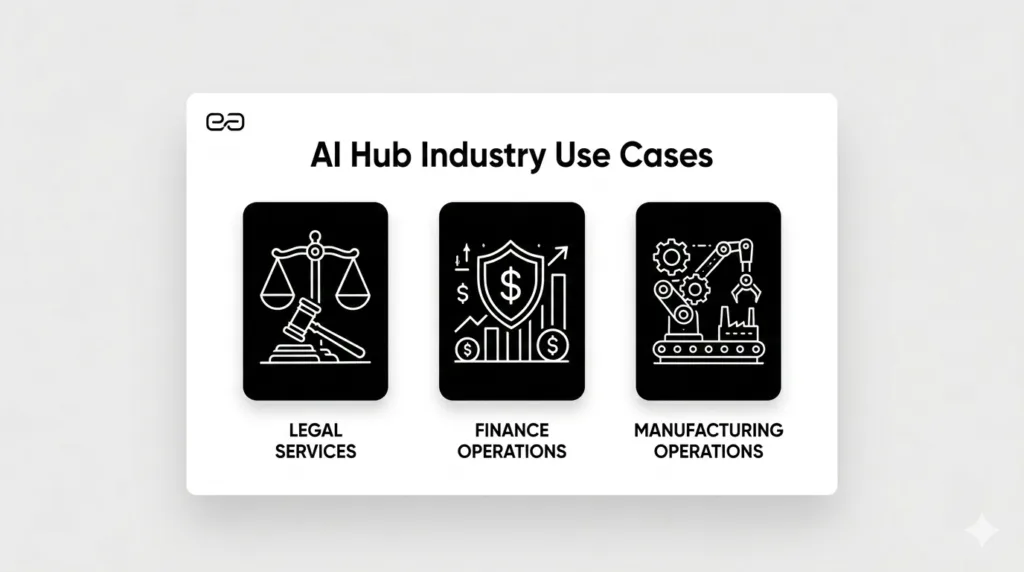
Finance: Traceable Audits Instead of manual sampling, the AI Hub monitors 100% of transactions. If an anomaly is found, the Hub doesn’t just flag it; it provides the data lineage showing exactly why the AI flagged it, making it “Audit-Ready.”
Legal: From Search to Action Legal teams are moving beyond “searching” for documents. Using the Beam Data AI Hub, agents can draft, redline, and file documents based on specific corporate playbooks, ensuring 100% compliance with internal standards.
Manufacturing & Operations: Silent Automation In global manufacturing hubs, AI layers now monitor logistics in the background. If a shipment is delayed, the AI re-routes it autonomously. Enterprises often look for recommendations for customizable AI interview platforms in manufacturing hubs to scale their workforce; a true AI hub integrates these niche interview tools into the broader corporate data strategy.
6. Overcoming “AI Sprawl” and “Shadow AI”
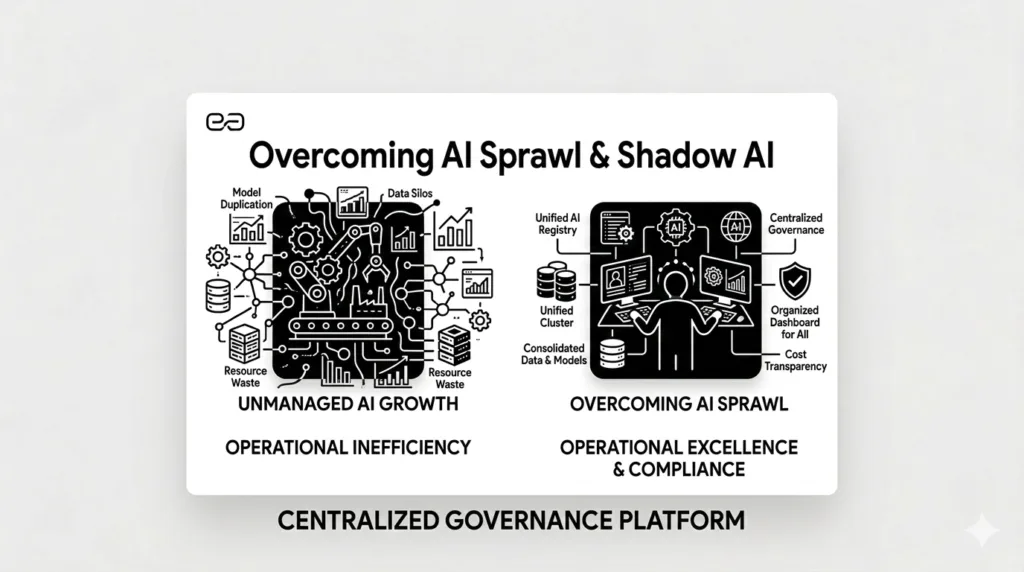
“AI Sprawl” occurs when every department buys its own AI software. This leads to redundant costs and massive security holes.
The AI Hub platform consolidates these costs. By using Model Routing, the Hub sends simple tasks to “cheap” models and complex tasks to “expensive” models.
- The ROI of Centralization: Most firms see a 30-40% reduction in token costs simply through intelligent caching and routing provided by a centralized AI hub or similar architecture.
7. Implementation Roadmap: From Pilot to Platform
- Audit: Identify where “Shadow AI” is currently happening in your firm.
- Centralize: Move all API keys and data connections into the Hub.
- Govern: Apply semantic guardrails and PII filters.
- Scale: Once the foundation is secure, deploy agentic workflows like the AI hub to automate cross-departmental tasks.
8. Conclusion: The AI Hub as a Strategic Asset
In 2026, the competitive advantage isn’t who has the best model; it`s who has the best Operating Layer. The model is the commodity; the orchestration is the edge.
As organizations mature, they realize that a fragmented approach to AI is a liability. By adopting a unified hub ai platform, you aren’t just buying software—you are building the infrastructure for the next decade of business.
Are you ready to move from AI experiments to an AI-powered enterprise? Explore the Beam Data AI Hub Platform Today.
Frequently Asked Questions
Q1: What is the “Pilot Trap” and how does an AI Hub help avoid it?
The “Pilot Trap” is when AI projects get stuck in the demo phase, failing to reach full operational deployment. An AI Hub Platform like Beam Data’s AI Hub for enterprise teams helps avoid this by providing a structured, governed, and scalable environment. It moves organizations beyond isolated AI tools to integrated, enterprise-wide AI systems.
Q2: How does an AI Hub Platform prevent “Shadow AI” and data leakage?
An AI Hub Platform centralizes all AI interactions, routing traffic through a governed layer. This allows for consistent security policies and monitoring of data usage. It prevents employees from using unmanaged, insecure AI tools that could expose sensitive information, eliminating “Shadow AI.”
Q3: What does “Orchestration” mean in the context of an AI Hub?
Orchestration means the AI Hub actively manages the entire “Logic Flow” of AI processes. It intelligently decides which models to use, applies business rules, and validates outputs. For example, the Beam Data AI Hub excels at orchestrating complex multi-agent workflows and applying semantic guardrails for predictable results.
Q4: How does an AI Hub address “Model Drift”?
An AI Hub provides Unified Model Governance, including centralized version control and performance monitoring. This helps detect and mitigate “Model Drift,” where AI models degrade in performance over time. It ensures models remain accurate and effective.
Q5: What are the key benefits of centralizing AI with an AI Hub Platform?
Centralizing AI with an AI Hub Platform offers enhanced security, compliance, and reduced “AI Sprawl” costs. It improves operational efficiency through intelligent orchestration. Platforms like the Beam Data AI Hub enable scalable AI initiatives across the enterprise with consistent governance.