
Key Takeaways
- On prem meaning in 2026: It is a deliberate deployment strategy for organizations that require full data custody, strict regulatory compliance, low-latency AI execution, and direct control over how enterprise AI systems process sensitive workloads.
- Which is better, cloud or on-premise? The answer is neither universal. IDC projects that 75% of enterprises will operate hybrid environments by 2027 because different workloads carry different risk profiles. Deployment decisions should follow workload classification, not vendor ideology.
- Is on-premise becoming obsolete? No. For high-volume and regulated AI workloads, on-premise infrastructure is becoming more strategically important. Dell/ESG research found on-prem can be 62% more cost-effective than public cloud for sustained inference workloads.
- 57% of enterprises cite data privacy as the largest barrier to AI adoption in the cloud (IBM). Deloitte’s 2026 research found that 55% avoid certain AI use cases entirely because of cloud data security concerns.
- AI Hub by Beam Data supports all three deployment tiers — cloud, private cloud/VPC, and on-premise — with full capability parity. Deployment decisions can therefore be made per workload, not constrained by platform limitations.
1. The Question That Keeps Coming Back
Cloud-first was once treated as the final answer for enterprise infrastructure. Between 2015 and 2022, the consensus was simple: move everything to the cloud as quickly as possible. For early AI experimentation, that approach made sense — low upfront costs, rapid deployment, and no hardware procurement delays.
In 2026, that experimentation phase is over. AI systems are now running production workflows, processing regulated data, and supporting autonomous agents at scale. As inference volumes rise and audit requirements become enforceable, enterprises are asking different questions: where does the data actually reside, and who has legal access to it?
55% of enterprises are avoiding at least some AI use cases because of cloud data security concerns. This is no longer a niche compliance issue — it is a mainstream barrier to AI adoption (Deloitte, 2026).
This blog is written for enterprise leaders evaluating real deployment decisions for AI workloads in 2026. It covers the practical trade-offs between cloud and on-premise infrastructure, where each model performs best, and how to design a secure AI deployment strategy without forcing a binary choice.
2. What Is On-Prem — And Is It Outdated?
On-premise infrastructure can be defined as referring to AI systems deployed within an organization’s own data centers or private servers, where the organization controls hardware, networking, security, data access, and model execution end to end.
In 2026, on-premise infrastructure is no longer associated primarily with legacy IT. It has become a strategic architecture choice for enterprises managing regulated, latency-sensitive, and high-volume AI workloads.
Is on-premise outdated?
For low-sensitivity, burst, or experimental AI workloads, public cloud infrastructure is usually more efficient. Cloud economics are difficult to beat for rapid experimentation and short-term scaling.
For regulated and sustained AI workloads, however, the economics shift. Research from Dell’s Enterprise Strategy Group found that enterprises investing roughly $1.96 million upfront in on-premise AI infrastructure achieved a four-year ROI of 1,225%. At steady-state inference scale, on-premise deployments can become significantly more cost-effective than public cloud or API-based AI services.
Is on-premise becoming obsolete?
No. IDC projects that by 2027, 75% of enterprises will adopt hybrid deployment models that distribute workloads across on-premise, private cloud, and public cloud environments. This reflects two parallel realities: cloud adoption continues to grow, and on-premise infrastructure is becoming more strategically important for workloads that demand stronger compliance, lower latency, predictable costs, and tighter data control.
3. Cloud vs On-Premise Comparison Chart
The cloud vs on-premise debate depends entirely on which operational dimension is being evaluated. Enterprise AI deployment decisions in 2026 are typically driven by seven core factors: cost structure, scalability, latency, data control, compliance requirements, operational flexibility, and long-term infrastructure efficiency.
| Dimension | Cloud | On-Premise / Private Cloud |
| Security & control | Shared responsibility model — provider manages infrastructure security while the organization manages data configuration, IAM, and prompt security. | Organization controls the full security stack, providing maximum data custody. Risk increases if patching and maintenance discipline decline. |
| Cost model | Pay-as-you-go pricing with low upfront cost, but variable expenses can rise quickly at sustained inference scale. | Higher upfront CAPEX, but significantly more cost-effective for high-volume, long-term AI workloads. |
| Scalability | Near-infinite elastic scaling, ideal for burst training and unpredictable workloads. | Fixed but upgradeable capacity, optimized for stable high-volume inference environments. |
| Latency | Network hops can introduce delay, acceptable for batch processing but less ideal for real-time agentic systems. | Co-located compute and storage minimize latency, making it well suited for real-time AI operations. |
| On-prem vs cloud storage | Cloud storage is scalable and managed, but data crosses organizational boundaries during processing. | Data remains within the organization’s infrastructure boundary, supporting stricter regulatory control. |
| Compliance | Certifications like SOC 2 and ISO 27001 support compliance, though governance responsibilities still remain with the organization. | Full compliance chain remains internal, providing cleaner auditability for highly regulated workloads. |
| Deployment speed | Rapid deployment within hours and no hardware procurement required, ideal for pilots and experimentation. | Deployment may take weeks or months due to hardware setup, but delivers stronger economics at production scale. |
Reading the comparison chart: cloud infrastructure generally wins on deployment speed, elasticity, and lower upfront cost. On-premise infrastructure performs better for data custody, predictable high-volume inference economics, latency-sensitive workloads, and regulated environments. The right decision is determined by workload profile — not ideology.
4. Cloud vs On-Premise Security: What Each Model Actually Requires You to Own
Cloud vs on-premise security is not a simple win for either model in 2026. The real distinction lies in the shared responsibility model — specifically, which parts of the security stack the organization is responsible for controlling and proving.
What cloud security requires you to own
Cloud providers such as AWS, Azure, and Google Cloud manage the physical infrastructure, networking layer, and hypervisor security. These platforms maintain mature certifications including SOC 2, ISO 27001, and FedRAMP.
What organizations still own in cloud AI environments includes IAM configuration, data classification before sensitive data enters AI systems, prompt security, data leakage prevention, and compliance with regulations such as GDPR and the EU AI Act. Organizations must also accept jurisdictional exposure, since foreign legal frameworks may apply to cloud providers regardless of server location.
What on-premise security requires you to own
On-premise infrastructure provides maximum data custody — no shared tenancy, no third-party processing layer, and reduced foreign jurisdiction exposure. In exchange, the organization becomes responsible for the full security lifecycle.
This includes physical access controls, infrastructure hardening, patch management, incident response, and hardware lifecycle operations. One of the most underestimated risks in on-premise environments is inconsistent patching discipline, which can create greater exposure than well-managed cloud deployments.
As StackAI’s 2026 enterprise deployment framework states: “You are not choosing cloud or on-prem — you are choosing what you can consistently control and prove.” The security decision is fundamentally about operational ownership capacity.
Agentic AI changes the security calculus
Traditional AI queries create limited and predictable security exposure. Agentic AI systems introduce continuous, high-frequency interactions across databases, APIs, and enterprise systems.
In public cloud environments, each agent action can become a data residency and jurisdictional event. In on-premise or private cloud deployments, the entire execution loop remains inside the organizational security boundary. For regulated, multi-agent AI workflows, this creates a structural security advantage that configuration alone cannot fully replicate in public cloud infrastructure.
5. On-Premise vs Private Cloud: Understanding the Middle Ground
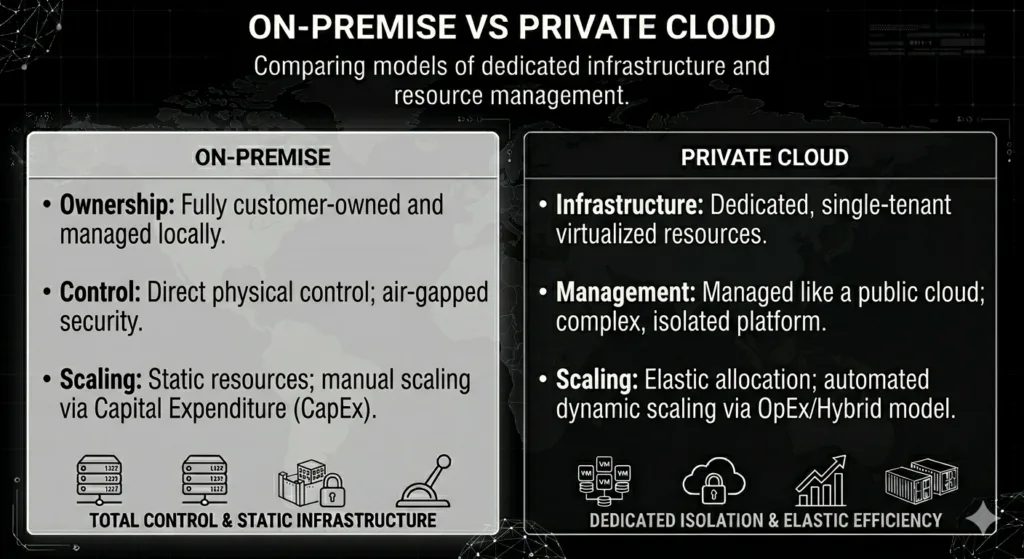
The distinction between on-premise and private cloud is one of the most misunderstood areas in enterprise AI deployment. While they are often grouped together, they represent different architectural models with different operational implications.
On-Premise vs Private Cloud: Key Differences
- Infrastructure ownership:
On-premise infrastructure is physically owned and operated by the organization, while private cloud infrastructure may be hosted by a provider but remains dedicated to a single tenant. - Operational model:
On-premise environments require the organization to manage hardware, patching, and maintenance directly. Private cloud environments typically include cloud-style automation and managed operations. - Data exposure and tenancy:
Both models support strong data residency and governance controls, but private cloud removes shared tenancy while preserving cloud operational flexibility.
In this way, subtle yet strong differences arise between both these models that ultimately affect stakeholder’s decision.
6. The Workload Classification Framework: Which Workloads Belong Where
The practical answer to “which deployment model should I use?” is not a company-wide policy decision. It is a workload classification exercise.
Tier 1 — Sovereign-required: on-premise or private cloud
This category includes patient health record inference, financial transaction processing, legal document AI, government systems, and workloads governed by frameworks such as HIPAA, GDPR Article 9, or DORA. These systems require full data custody and minimal jurisdictional exposure.
Tier 2 — Sensitive but scalable: private cloud or hybrid
Customer analytics, supply chain optimization, HR document processing, and internal knowledge systems often involve sensitive but not strictly regulated data. These workloads benefit from elastic scaling while still requiring residency and governance controls. Private cloud and sovereign hyperscaler configurations are well suited here.
Tier 3 — Non-sensitive or burst: public cloud
Public cloud is typically the best fit for experimentation, model training on anonymized data, seasonal burst inference, and public-facing AI services. These workloads benefit most from elastic GPU capacity and variable cost economics.
On-premise vs cloud example: financial services
A major bank may process live transaction data and risk inference on-premise to satisfy DORA and GDPR requirements, while simultaneously using public cloud infrastructure for fraud detection model training on anonymized datasets. Different workload profiles justify different deployment models within the same organization.
On-premise vs cloud example: retail
A national retailer may use cloud infrastructure for recommendation model training and demand forecasting, while operating in-store inventory management agents on-premise to meet sub-100ms latency requirements. This is not an architectural compromise — it is workload optimization.
7. The Decision Framework: Three Questions to Answer Before Choosing
The cloud versus on-premise debate becomes more practical when reduced to three operational questions applied to each workload.
- What is the data sensitivity and compliance obligation?
Regulated personal, financial, and health data impose residency and governance requirements that immediately narrow deployment options. - What is the workload’s volume and latency profile?
Experimental and burst workloads favor cloud economics. Sustained inference and latency-sensitive agentic systems favor on-premise or private cloud environments. - What can your team consistently own and maintain?
Cloud environments can be safer for under-resourced teams because infrastructure responsibilities are shared. On-premise environments only provide an advantage when organizations can maintain operational discipline consistently.
8. How Beam Data AI Hub Removes the Deployment Dilemma
Most AI platforms force deployment trade-offs. Cloud-first platforms often lose governance capability in sovereign environments, while on-premise platforms may lack operational flexibility and scaling efficiency.
AI Hub by Beam Data is designed to operate across public cloud, private cloud/VPC, and on-premise deployments with full capability parity. Governance controls, semantic security, agent orchestration, immutable audit trails, MCP-native integrations, and industry-specific agents remain consistent across every environment.
In practice, this allows enterprises to run Tier 1 regulated workloads on-premise, Tier 2 workloads in private cloud, and Tier 3 experimental workloads in public cloud — all under a unified governance and control framework. Deployment decisions are therefore made per workload, not constrained by platform architecture.
AI Hub by Beam Data allows organizations to align deployment models with governance and compliance requirements without sacrificing platform consistency or capability.
For enterprises using the workload classification framework above, AI Hub’s architecture ensures regulated data processed in on-premise or private cloud deployments remains inside the organizational boundary throughout execution — not just at storage level.
Ready to map your AI workloads to the right deployment model? Schedule a 30-minute architecture review with the Beam Data team or download the AI Deployment Strategy Workload Assessment to classify your current AI portfolio by deployment tier.
Frequently Asked Questions
1. What is on prem and how does it differ from cloud AI deployment?
On-premise AI infrastructure runs within an organization’s own data centers or private servers, where the organization controls hardware, security, and data handling. Cloud AI is hosted by providers such as AWS, Azure, or Google Cloud and accessed remotely through usage-based services.
2. Is on-premise outdated for enterprise AI in 2026?
No. On-premise infrastructure is increasingly important for high-volume, regulated, and latency-sensitive AI workloads. IDC projects 75% of enterprises will adopt hybrid deployment models by 2027.
3. What are the main disadvantages of on-prem AI infrastructure?
The biggest challenges are high upfront costs, longer deployment timelines, full responsibility for security and patching, and ongoing hardware management. It is less suitable for organizations without dedicated infrastructure teams.
4. What is the difference between on-premise vs private cloud for AI?
On-premise infrastructure is owned and operated directly by the organization. Private cloud uses dedicated infrastructure with cloud-style automation and management, but without shared tenancy or public cloud exposure.
5. Which is better for cloud vs on-premise security?
Neither is universally better. Cloud providers offer strong infrastructure security, while organizations still manage governance and access controls. On-premise provides maximum control but also full operational responsibility.
6. Can you give an on-premise vs cloud example from a regulated industry?
A bank may run live transaction processing and risk inference on-premise for compliance reasons, while using public cloud infrastructure for fraud detection model training on anonymized data.
7. How does Beam Data AI Hub support all three deployment models?
AI Hub by Beam Data supports on-premise, private cloud/VPC, and public cloud deployments with consistent governance, security, audit trails, and agent orchestration across every environment.