
Key Takeaways
- Sovereign AI is not a policy trend — it is a structural shift in how enterprises select, deploy, and govern AI infrastructure. 83% of companies now view it as at least moderately important to strategic planning (Deloitte, 2026).
- Sovereign AI is an organization’s or nation’s ability to develop and control AI capabilities across four dimensions: where data physically resides, who operates the infrastructure, who owns the underlying technology, and which legal frameworks govern it.
- Global sovereign AI investment is projected to exceed $100 billion in 2026 — up from near zero in 2022. Countries including France, Canada, and the UAE are treating compute as critical national infrastructure.
- Data residency has evolved from a compliance checkbox to a security imperative. 65% of IT leaders have already restructured their cloud strategies in response to geopolitical pressure (Kyndryl, 2026).
- AI Hub by Beam Data is designed for sovereign-first enterprise deployment — full capability in on-premise and private VPC configurations, with no feature trade-offs for regulated industry environments
1. The Shift from Cloud-First to Sovereign-First
In 2019, “cloud-first” was the default for enterprise AI strategy. Cost efficiency, scale, and access to advanced models made centralized cloud infrastructure the obvious choice. By 2026, many CIOs and CDOs are shifting toward a different model: sovereign-first.
This shift is not driven by technology limitations. It is driven by geopolitics, regulation, and the realization that where AI runs — which jurisdiction governs it, who has legal access, and whether operations can be disrupted — matters as much as performance or scale.
83% of companies now view sovereign AI as at least moderately important to strategic planning, and 77% factor vendor country of origin into purchasing decisions. This is no longer niche — it is a mainstream procurement standard (Deloitte, 2026).
This blog is an entry point for enterprise leaders looking to understand what sovereign AI is, why it matters now, and what a sovereign-first AI strategy looks like in practice.
2. What is Sovereign AI Definition: What It Actually Means
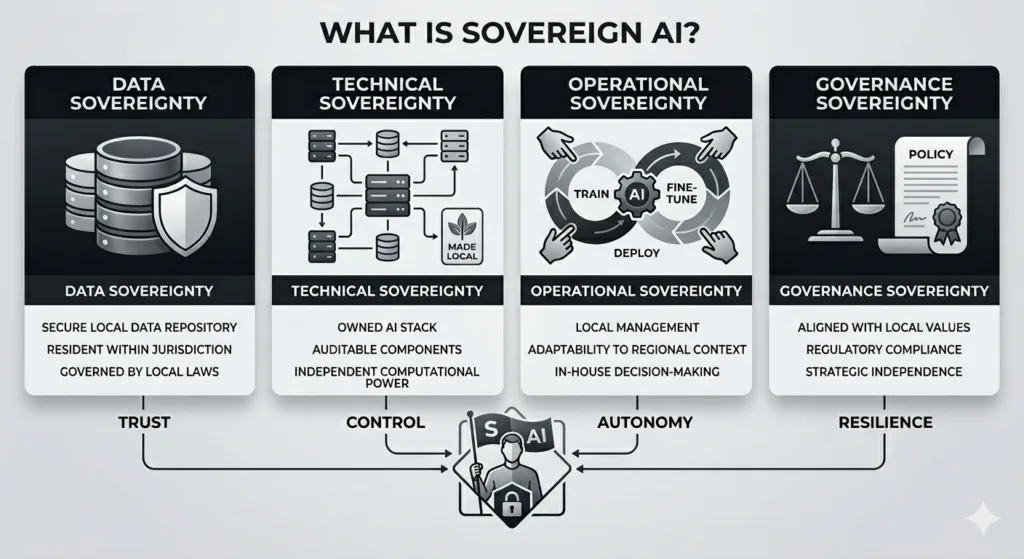
Sovereign AI is an organization’s or nation’s ability to develop and control AI capabilities across four dimensions: where data and computers physically reside, who manages and secures the infrastructure, who owns the underlying technology and IP, and which legal frameworks govern usage and enforcement.
That definition, however, is more layered than it first appears. The concept operates across multiple dimensions that together shape enterprise decision-making — and no single dimension alone determines whether an organization has achieved meaningful sovereignty. To be more specific, this definition is built on four components:
- Territorial — where data and compute physically reside
- Operational — who manages and secures the infrastructure
- Technological — who owns the stack, models, and IP
- Regulatory — which legal frameworks govern usage and enforcement
An organization does not need to build infrastructure from scratch to achieve sovereignty. What matters is control: the ability to determine where data resides, how it is processed, who can access it, and which jurisdiction governs it.
Sovereignty in AI is about control, not isolation. The goal is strategic independence — reducing exposure to legal and operational risks tied to foreign-governed infrastructure — while still leveraging global technological capability.
3. Sovereign AI Countries: The Global Investment Picture
To understand why sovereign AI has moved from policy debate to an enterprise procurement requirement, it helps to look at the scale of investment. The numbers are large enough to reshape the global AI infrastructure market.
Global sovereign AI investment is projected to exceed $100 billion in 2026 — a figure that was near zero just a few years ago. Governments are not only funding AI research; they are building the physical compute layer: GPU clusters, AI-ready data centers, energy infrastructure, and regulatory frameworks that enable domestic AI deployment at scale.
| Country | Sovereign AI Investment & Strategy | Key Data Residency Requirement |
| France | EUR 109B AI infrastructure investment by 2030. Nuclear-powered supercomputer campuses, strict EU data residency rules. | All AI workloads for public sector and critical industries must remain within EU/France jurisdiction. |
| Canada | Sovereign AI Canada: hydroelectric-powered compute, Montreal/Toronto/Edmonton AI research clusters, PIPEDA compliance. | In-country data processing for Microsoft 365 Copilot confirmed for 2026. Provincial health data laws add additional residency layers. |
| UAE | Sovereign wealth fund capital deployed into national AI clouds and GPU infrastructure. Arabic-language model development priority. | UAE data protection law requires personal data processed for UAE residents to remain in-territory. |
| India | National AI Mission prioritizes localized language support and domestic data sovereignty as foundational requirements. | Digital Personal Data Protection Act (2023) creates data localization obligations for sensitive personal data. |
| EU (broadly) | EUR 200B+ combined EU and member-state AI investment. EU AI Act creates compliance obligations that effectively mandate sovereign deployment for high-risk systems. | GDPR + EU AI Act together require data residency, audit trails, and explainability — effectively a sovereign AI compliance stack. |
The pattern across these sovereign AI examples is consistent: nations are building sovereign AI cloud infrastructure not to isolate themselves from global capability, but to ensure critical workloads can operate independently if geopolitical conditions shift. The infrastructure functions as both strategic asset and risk mitigation.
For enterprises operating in these markets, these national programs create both regulatory expectations and commercial opportunities. Organizations that adopt sovereign-compatible AI architectures early are better positioned to access government contracts, regulated industry partnerships, and procurement processes that increasingly require domestic data residency as a baseline.
4. Why Data Residency Is Now a Security Standard, Not a Compliance Checkbox
Until recently, data residency requirements were treated primarily as a compliance burden — organizations stored data locally to satisfy regulations, with security seen as a secondary benefit. That framing has now reversed.
The geopolitical trigger
The shift began with the recognition that foreign governments can subpoena or restrict access to data stored on infrastructure under their legal jurisdiction, regardless of where the deploying organization is based. Laws like the US CLOUD Act allow authorities to compel disclosure of data held by domestically incorporated providers, even if that data is stored internationally. When the governing jurisdiction changes, the security posture changes with it.
Gartner has coined a term for the enterprise response: geopatriation — the movement of AI workloads from global public clouds into sovereign or local environments. Combined with geopolitical tensions, this is driving a significant shift toward local infrastructure, with many IT leaders already adjusting cloud strategies in response.
The agentic AI multiplier
Single-turn AI queries present limited data residency risk. Multi-agent workflows introduce continuous, high-velocity data flows across systems. Agents accessing financial records, health data, or customer information in real time significantly increase exposure.
An agent processing sensitive data, making decisions, and logging outcomes is not just computation — it is continuous data processing. Every stage of that process must remain within the defined jurisdictional boundary. That is the new baseline for data residency.
Three risk dimensions data residency now addresses
- Jurisdictional risk — Foreign legal frameworks can access data on infrastructure they govern, regardless of origin.
- Vendor concentration risk — Dependence on a single hyperscaler under foreign jurisdiction creates fragility.
- Agentic execution risk — Autonomous agents handling regulated data across borders introduce new forms of legal exposure.
5. What Sovereign AI Means for Enterprise Procurement in 2026
The macro trend translates directly into changed procurement behavior. The Deloitte 2026 State of AI in the Enterprise found that 58% of organizations now build AI stacks primarily with local vendors — a shift from just a few years ago when selection was driven almost entirely by capability benchmarks.
Country of origin is a vendor selection criterion
77% of enterprises now factor a vendor’s country of origin into AI purchasing decisions. This makes sovereign AI tools — platforms deployable domestically with full data residency guarantees — a default requirement in regulated industries such as financial services, healthcare, government, and defense.
The evaluation question has shifted. It is no longer “which AI platform performs best?” but “which AI platform can operate within my jurisdiction without compromising production capabilities?”
The sovereign AI cloud as enterprise infrastructure
A sovereign AI cloud is not limited to government use. It is infrastructure deployed within a defined jurisdiction, governed by domestic law, with guarantees that data does not cross legal boundaries without consent. Offerings like Microsoft Sovereign Landing Zone, Google Distributed Cloud, and AWS GovCloud reflect hyperscaler responses to this demand. The real question is not where servers sit, but who has legal and operational control.
The three questions every CIO must answer
- Where does my AI data actually reside?
Not where the vendor claims — where contracts define, under which legal jurisdiction, and with what audit rights. - Under which legal framework does my AI vendor operate?
If the vendor is incorporated in a foreign jurisdiction, that jurisdiction’s laws may apply regardless of server location. - If geopolitical conditions change tomorrow, can my AI operations continue without interruption?
Infrastructure resilience and sovereignty independence are effectively the same question.
6. Building a Sovereign-First AI Strategy: A Practical Framework
The transition from cloud-first to sovereign-first is a multi-year journey. McKinsey’s 2026 analysis found that sovereign AI cloud migrations typically take three to four years — not because of technology constraints, but because of the organizational work required to classify, move, and re-govern regulated workloads. Enterprises that begin this process early will have a structural advantage as agentic AI increases dependence on controlled infrastructure.
Step 1: Classify workloads by sovereignty requirement
Not every AI workload requires sovereign infrastructure. Map your AI systems into three tiers: sovereign-required (regulated data, sensitive PII, government contracts), sovereign-preferred (commercially sensitive or IP-critical), and standard (non-sensitive, public-facing). This classification determines the appropriate deployment model and tooling.
Step 2: Audit jurisdictional exposure across your current AI stack
Map each AI system to the legal jurisdiction governing its infrastructure. Include SaaS AI tools that process enterprise data, as these often introduce hidden exposure. Most organizations discover more foreign jurisdiction dependency than expected, particularly through embedded AI in productivity tools.
Step 3: Evaluate sovereign AI tools for deployment flexibility without feature trade-offs
The key test for sovereign capability is whether on-premise or private VPC deployments maintain full feature parity with cloud versions. Platforms that degrade functionality in sovereign setups are not truly sovereign. Require vendors to demonstrate parity explicitly as part of procurement.
7. Sovereignty Is Infrastructure, Not Policy
The most important reframe in this blog is this: sovereignty is not a compliance constraint imposed on AI programs. It is the infrastructure investment that makes AI programs durable — resilient to geopolitical disruption, regulatory change, and the jurisdictional risks that come with deploying autonomous systems at enterprise scale.
The organizations building sovereign AI infrastructure now — classifying workloads, auditing jurisdictional exposure, selecting sovereign AI tools with genuine deployment flexibility — are making an investment that compounds. When regulatory shifts arrive or agentic AI expands into more sensitive domains, the infrastructure foundation is already in place. Retrofitting sovereignty into an existing AI program is consistently more expensive than building it in from the start.
Google Cloud VP Jai Haridas put the directional shift clearly at Google Cloud Next, April 2026: “Customers and industries have evolved from a cloud-first strategy to a sovereign-first strategy.” The question is no longer whether to prioritize sovereignty. It is how to implement it without sacrificing the AI capabilities enterprises need to compete.
8. Build Sovereign First Deployment with AI Hub
AI Hub by Beam Data enables sovereign-first AI deployment by running fully within an organization’s jurisdictional boundary, with complete data residency and no loss of agentic AI capabilities. Designed for on-premise and private VPC environments, it provides full feature parity including semantic security, audit trails, kill-switch controls, MCP-native access, and domain-specific agents.
All governance—agent actions, data access, and workflow execution—remains within the defined security perimeter, ensuring sovereignty across data at rest, in motion, and during inference.
Built for emerging regulatory needs in regions like the EU, UAE, India, and Canada, AI Hub aligns AI infrastructure with local compliance requirements while maintaining production-grade agentic performance.
Explore how AI Hub supports sovereign AI deployment—book a 30-minute session with us today!
Frequently Asked Questions
1. What is sovereign AI and why does it matter for enterprises in 2026?
Sovereign AI refers to the ability of a nation or organization to develop, deploy, and govern AI systems using infrastructure, data, and legal frameworks under domestic or organizational control — not subject to foreign jurisdiction. It matters in 2026 because geopolitical instability, the EU AI Act, and rising enterprise awareness of jurisdictional risk have made data residency and infrastructure control central procurement requirements.
2. Which sovereign AI countries are leading investment in 2026?
France leads in Europe with major long-term AI infrastructure commitments. Sovereign AI Canada stands out by combining research talent, clean energy compute, and PIPEDA compliance. The UAE, Saudi Arabia, and India are also investing heavily in national AI capabilities.
3. What are the best sovereign AI examples from regulated industries?
In financial services, EU banks deploy AI under DORA and GDPR using sovereign or on-prem setups. In healthcare, patient data remains within national frameworks. While in government and defense, countries like Canada and Germany are building private AI clouds.
4. What are sovereign AI tools and how do I evaluate them?
Sovereign AI tools are platforms that can run within defined jurisdictional boundaries without losing capability. The key evaluation factor is feature parity—whether governance, security, and orchestration remain intact in sovereign deployments.
5. What is sovereign AI Canada’s significance for enterprise strategy?
Sovereign AI Canada shows that strong national capability doesn’t require EU-scale investment. Its mix of research strength, clean infrastructure, and data protection laws provides a practical model for enterprises.
6. How does Beam Data AI Hub support sovereign AI deployment?
AI Hub by Beam Data supports on-premise and private VPC deployment with full feature parity. Enterprises can run agentic AI workflows within required legal boundaries while maintaining auditability, security, and compliance controls.
References
Deloitte. State of AI in the Enterprise 2026: The Sovereign Shift. Deloitte Development LLC, 2026.
Gartner. The Rise of Geopatriation: Moving AI Workloads to Sovereign Environments. Gartner Research, 2025.
Haridas, Jai. “Sovereign-First: The New Cloud Strategy.” Google Cloud Next, Apr. 2026, San Francisco, CA. Keynote Address.
Kyndryl. 2026 Global Cloud Survey: Geopolitics and Infrastructure Resilience. Kyndryl Inc., 2026.
McKinsey & Company. Sovereign AI: The Three-Year Migration Roadmap. McKinsey Digital, 2026.