
Key Takeaways
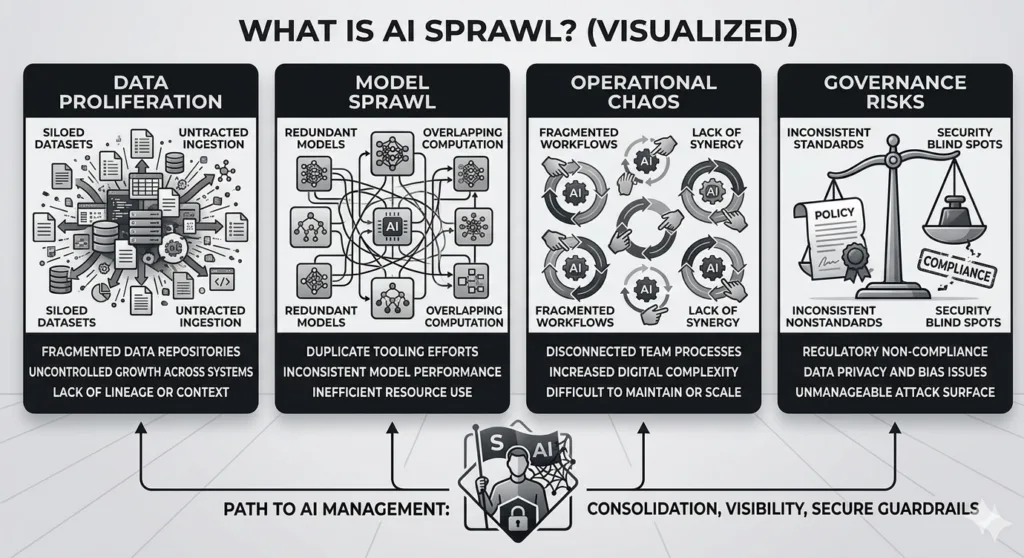
- AI sprawl is the uncontrolled proliferation of disconnected AI agents and tools across an organization without a shared data foundation or governance layer, resulting in fragmented context, inconsistent outputs, duplicated functionality, and increasing integration and compliance overhead as deployments scale.
- The average enterprise runs 897 applications — only 29% are connected. This fragmentation is the root cause of AI sprawl: agents proliferate across the organization while their data remains trapped in isolated systems.
- 70% of data and analytics leaders believe their most valuable insights sit in the 19% of data that is siloed, inaccessible, or unusable (Salesforce, 2026). AI cannot surface what it cannot access.
- Gartner warns that 60% of organizations will abandon AI projects through 2026 when data is not prepared for advanced analytics. The constraint is data readiness, not model capability.
- AI sprawl and data silos are two expressions of the same problem: fragmented AI creates new data silos, and fragmented data produces inconsistent AI outputs.
- AI Hub by Beam Data provides a unified, governed data layer that resolves both — enabling clean, connected, and agent-accessible enterprise data across every function.
1. The Problem Has a Name: AI Sprawl
For years, enterprise technology teams focused on SaaS sprawl — overlapping applications, fragmented data, and limited visibility across the business. The response was familiar: data warehouses, integration platforms, and engineering-heavy stitching of systems. Progress was incremental but manageable.
In 2026, a more complex challenge emerged: AI sprawl — and it is scaling faster than SaaS sprawl ever did.
What began as isolated productivity pilots has evolved into a fragmented ecosystem of disconnected AI agents. The challenge for IT leaders is no longer adoption — it is control. — onereach.ai, March 2026
AI sprawl is fundamentally a data problem, not a tooling problem. Every department-deployed AI agent introduces a new isolated context: its own memory, its own data connections, and its own outputs that are invisible to other agents across the organization.
The result is not coordinated intelligence. It is parallel silos built at machine speed.
The scale of the issue is already visible:
- The average enterprise runs 897 applications, only 29% connected
- 19% of enterprise data is siloed or inaccessible
- 70% of leaders believe their most valuable insights sit inside that inaccessible data (Salesforce, 2026)
The constraint is no longer data volume — it is data usability and connectivity.
2. Why Siloed Data Makes AI Systems Unreliable
The link between data silos and AI failure is direct. The issue is not model capability — it is incomplete context at execution time.
The context collapse problem
AI agents depend on complete, cross-domain context to produce correct outputs. When data is fragmented across systems, agents compensate with inference rather than certainty.
This leads to predictable failure modes:
- Customer support agents missing billing context
- Procurement agents ignoring supplier risk signals
- Operations agents acting on partial system state
Even when individual systems perform correctly, the combined output becomes unreliable because no single agent sees the full picture.
As KNIME CEO Michael Berthold notes, agents must repeatedly jump across systems — CRM, support, analytics — to reconstruct context that should already be unified. Without that, decisions are made on fragmented inputs rather than a single source of truth.
The trust problem
Inconsistent data sources produce inconsistent AI outputs. Once teams observe contradictions between agents, they stop trusting automation and revert to manual validation.
Gartner reports that 63% of organizations lack confidence in their AI data readiness. A majority of AI initiatives fail to scale due to data constraints rather than model limitations. The result is not just inefficiency — it is adoption collapse.
The governance gap
Siloed data fragments compliance. When systems operate under different access rules, retention policies, and audit standards, AI agents inherit inconsistent governance boundaries.
This creates a structural risk: AI systems begin operating across data they were never designed to jointly access or reason over.
3. AI Sprawl by Function: Where Silos Create Failures
Data fragmentation impacts every enterprise function differently, but the underlying mechanism is the same: incomplete context produces incorrect automation at scale.
| Business Function | Siloed Data Problem | AI Failure Mode |
| Financial Services | Risk, compliance, and customer data split across systems | Incomplete risk assessment due to missing cross-system signals |
| Healthcare | Patient records fragmented across clinical, billing, and care systems | Unsafe or incomplete care recommendations |
| Retail / Supply Chain | Inventory, demand, and supplier data disconnected | Over/under ordering due to partial visibility |
| Sales & Marketing | CRM and engagement data not unified | Misaligned lead scoring and targeting |
| Manufacturing | Production, maintenance, and quality data isolated | Missed failure patterns and downtime risk |
Across all functions, the pattern is consistent: AI does not fail because models are weak. It fails because the system feeding them is fragmented.
4. Why AI Sprawl Compounds the Silo Problem
Data silos create unreliable AI outputs. AI sprawl makes the problem worse by creating entirely new silos every time disconnected agents are deployed across the organization.
Shadow AI becomes a silo factory
When departments deploy standalone AI agents independently, each system develops its own data connections, prompting logic, and workflow memory. Marketing, sales, finance, and operations may all run AI on the same business processes — but from different datasets and governance standards.
The result is fragmented decision-making: multiple agents producing conflicting recommendations from incomplete context.
As onereach.ai noted in 2026, department-deployed agents do not just solve local problems — they create new disconnected data silos and additional security exposure. Every new agent adds integration complexity that is rarely governed or sustainably maintained.
Fragmented context creates fragmented intelligence
Enterprise AI only compounds in value when systems operate from shared organizational context.
Without a unified data foundation, each agent maintains isolated memory and disconnected workflows. Intelligence does not accumulate across the enterprise — it fragments into separate operational silos.
The solution is a shared intelligence layer combining:
- Canonical knowledge: a governed semantic layer ensuring every agent accesses the same trusted enterprise data
- Contextual memory: shared workflow history and interaction state preserved across teams, systems, and business functions
Together, these layers allow AI systems to operate with cumulative organizational intelligence rather than isolated departmental context.
5. The Five Principles of Unified Enterprise Data
Breaking the AI sprawl and data silo cycle requires more than another integration platform. Enterprise AI in 2026 depends on a governed data architecture built around five core principles.
1. Single source of truth — not a single database
Unified enterprise data does not mean moving every dataset into one system. It means creating a governed access layer where every AI agent queries a consistent, authoritative view of enterprise data across functions and environments.
2. Provenance and lineage at the record level
Every record an AI agent accesses should have traceable origin, update history, transformation history, and governance metadata. Without provenance, neither reliability nor auditability can be verified.
3. Governed access — not open access
Unified data must still enforce field-level permissions, residency controls, and audit logging. Unification without governance creates a data swamp. Unified governance creates trustworthy AI.
4. Real-time data currency for AI inference
Agentic workflows require current-state information. Batch-updated pipelines feeding yesterday’s data into real-time AI systems create hidden operational risk and unreliable outputs.
5. Residency and sovereignty by design
Where enterprise data is processed determines which legal framework governs it. Unified AI infrastructure must preserve residency boundaries during agent execution — not just at storage level.
6. How Beam Data AI Hub Unifies Siloed Business Data
The principles above define what unified enterprise AI data requires. The next question is operational: which platform delivers it across cloud, private VPC, and sovereign on-premise environments?
AI Hub by Beam Data acts as the governed enterprise data foundation layer for AI systems. Instead of creating another disconnected integration layer, it gives every enterprise agent access to a single governed source of truth.
Connecting structured and unstructured enterprise data
AI Hub unifies structured systems like ERP, CRM, and financial databases with unstructured enterprise content including documents, reports, communications, and operational logs — allowing agents to operate with full business context.
MCP-native data access for AI agents
Native support for the Model Context Protocol (MCP) allows agents to dynamically discover and access enterprise data sources without rebuilding workflows when infrastructure changes.
Governance embedded directly into the data layer
Access controls, audit trails, residency enforcement, and semantic security operate at execution time — not as a separate compliance overlay after deployment.
Industry-specific enterprise intelligence
AI Hub includes verticalized data models and governance frameworks for Manufacturing, Finance, and EdTech, accelerating deployment for regulated enterprise environments.
AI Hub by Beam Data gives enterprise AI systems a unified, governed, and sovereign data foundation — transforming fragmented AI deployments into cumulative organizational intelligence.
7. Solve AI Sprawl with Beam Data
AI capability without unified data infrastructure produces faster wrong answers, not better decisions.
The organizations succeeding with enterprise AI in 2026 are not simply deploying more agents. They are building governed data foundations that allow every agent, workflow, and business function to operate from the same trusted source of truth.
Unified enterprise data is not the most visible part of AI transformation — but it is the layer that determines whether the entire investment compounds or fragments over time.
Ready to unify your enterprise AI data foundation? Schedule a 30-minute demo with the Beam Data team to see how AI Hub connects siloed business systems into a single governed layer for enterprise AI.
Author
By the Beam Data Team | Reviewed by Maliha, Content Editor
Frequently Asked Questions
AI sprawl is the rapid growth of disconnected AI agents across departments without unified governance or data access. Each new agent creates isolated workflows, inconsistent outputs, compliance risk, and rising integration complexity across the enterprise.
AI agents require complete context to generate reliable outputs. Data silos fragment that context — forcing agents to infer from incomplete information, which produces inconsistent and often incorrect decisions at scale.
Unified enterprise data means every AI agent accesses a single governed layer of trusted enterprise information — with provenance tracking, real-time updates, access controls, auditability, and residency enforcement built into the architecture.
SaaS sprawl created operational inefficiency through disconnected applications. AI sprawl creates fragmented intelligence — where agents generate conflicting outputs, duplicate decisions, and unmanaged data access risks across the organization.
AI Hub by Beam Data creates a unified governed data layer connecting structured and unstructured enterprise systems. MCP-native access, record-level controls, audit trails, and industry-specific governance allow every agent to operate from the same trusted source of truth.
Start with a full inventory of AI systems, data sources, and shadow AI deployments. Then prioritize the highest-impact siloed workflows first, unify those data layers, and expand incrementally across the enterprise.
References
Salesforce. “Study: 84% of Technical Leaders Need Data Overhaul for AI Strategies to Succeed.” Salesforce, 4 Nov. 2025, https://www.salesforce.com/news/stories/data-analytics-trends-2026/. Accessed 11 June 2026.
Slesarenko, Alla. “From AI Agent Sprawl to Unified AI Operations: How Enterprises Can Regain Control.” OneReach.ai, 11 Mar. 2026, https://onereach.ai/blog/from-ai-agent-sprawl-to-unified-ai-operations-how-enterprises-can-regain-control/. Accessed 11 June 2026.
O’Neill, Joseph. “Why Companies Who Fail to Control AI Agent Sprawl Will Fall Behind Forever.” OneReach.ai, 4 Mar. 2026, https://onereach.ai/blog/why-companies-who-fail-to-control-ai-agent-sprawl-will-fall-behind-forever/. Accessed 11 June 2026.
Goss, Max. “Gartner Identifies Six Steps to Manage AI Agent Sprawl.” Gartner, 28 Apr. 2026, https://www.gartner.com/en/newsroom/press-releases/2026-04-28-gartner-identifies-six-steps-to-manage-artificial-intelligence-agent-sprawl. Accessed 11 June 2026.Beam Data. “Solving AI Sprawl: How to Unify Siloed Business Data.” Beam Data, 2026, https://beamdata.ai/solving-ai-sprawl-how-to-unify-siloed-business-data/. Accessed 11 June 2026.