
Key Takeaways
- AI infrastructure modernization is the process of upgrading an organization’s compute, storage, data architecture, and networking capabilities to support enterprise-scale artificial intelligence. It serves as the foundation for scaling AI workloads efficiently, securely, and cost-effectively.
- Old IT infrastructure may not support modern AI tools. Legacy systems built for batch processing and manual governance cannot effectively support modern agentic AI workloads.
- AI modernization requires four connected layers: compute and storage, data foundation, orchestration runtime, and governance with observability. Modernizing only one layer creates limited outcomes.
- The modern AI infrastructure market is increasingly moving toward sovereign-first and hybrid deployment strategies where organizations require both performance and compliance.
- AI Hub by Beam Data supports all four layers through a unified control plane across on-premise, private VPC, and cloud deployments.
1. Why Infrastructure Is Where AI Strategy Lives or Dies
Most enterprises entering 2026 have an AI strategy. Far fewer have the infrastructure required to execute it successfully.
Research from McKinsey found that while many large organizations include sovereign AI in their roadmaps, fewer have detailed workload plans, budgets, and implementation structures in place. The strategic intent exists, but the operational foundation often does not.
The problem is usually not vision — it is sequencing. Organizations that prioritize AI capability before establishing infrastructure often encounter recurring issues: unreliable outputs caused by poor data quality, governance systems that cannot generate audit evidence, compliance bottlenecks, and costs that scale faster than business value.
“In AI, governance sets the rules. Infrastructure determines whether the game can be played at all.”
This guide builds on previous discussions around sovereign AI and deployment models by focusing on the infrastructure roadmap: what enterprise AI modernization looks like, the order in which it should happen, and how the components fit together.
2. Why Old IT Infrastructure May Not Support Modern AI Tools
One of the most underestimated risks in enterprise AI programs is assuming existing infrastructure can support modern AI with only incremental upgrades. In many environments, the limitations are architectural rather than computational.
The architectural mismatch
Old IT infrastructure may not support modern AI tools for several structural reasons:
- Data architecture mismatch: Legacy systems were built for batch analytics and structured reporting. Modern AI requires continuous, low-latency access across structured and unstructured data environments.
- Governance architecture mismatch: Traditional governance relied on periodic audits and reviews. Modern AI systems require real-time monitoring, audit trails, and automated policy controls. There is a difference in theoretical and operational governance in reality.
- Security perimeter mismatch: Older security models were designed around static systems and data boundaries, while agentic AI creates continuous movement across applications and workflows.
The consequence of legacy infrastructure debt
Organizations attempting to scale AI on unmodernized systems often follow a predictable pattern: pilots succeed in controlled environments, production systems expose data quality and governance gaps, and deployment slows under compliance pressure.
Industry trends increasingly show enterprises moving toward hybrid and sovereign infrastructure models that bring compute closer to data while maintaining operational consistency.
3. The Four Layers of Modern AI Infrastructure
Building AI infrastructure that is scalable, sovereign, and governable requires four connected layers. Each layer becomes the foundation for the next.
| Infrastructure Layer | Legacy State | Modernized State | Sovereign AI Platform Role |
| Computer & Storage | Shared cloud, limited residency, higher latency | Sovereign compute with co-located storage | Deploys across cloud, VPC, and on-prem with full parity |
| Data Foundation | Data silos, inconsistent schemas, no provenance | Governed pipelines with MCP-native access | Enforces governed and residency-aware data access |
| Orchestration & Runtime | Manual workflows with limited controls | Multi-agent orchestration with HITL controls | Provides orchestration with workflow enforcement |
| Governance & Observability | Manual audits and limited visibility | Real-time monitoring and audit trails | Embeds governance directly into execution |
Each layer is dependent on the one below it. Modernizing orchestration without modernizing data creates faster access to poor outputs, while adding governance on top of outdated infrastructure limits enforceability. Sequence matters as much as technology choice.
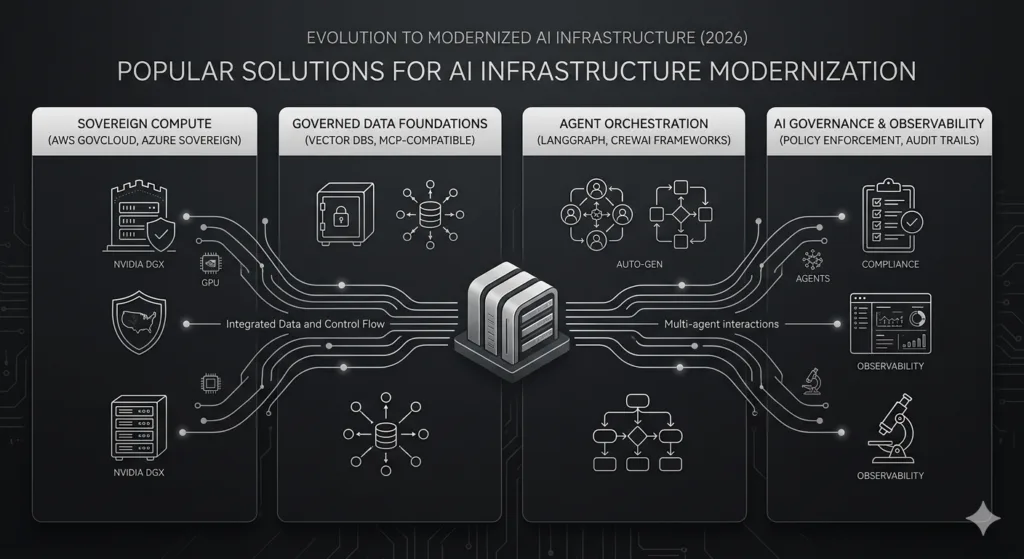
4. Popular Solutions for AI Infrastructure Modernization
The AI infrastructure market in 2026 has expanded beyond simple cloud adoption. Enterprise modernization strategies now span multiple technology layers, from computer infrastructure to governance and observability.
Computer and sovereign cloud infrastructure
The computer layer is increasingly centered around sovereign-capable environments. AWS GovCloud, Azure Sovereign Landing Zone, and Google Distributed Cloud provide cloud capabilities with domestic data residency controls. For on-premise environments, enterprise GPU infrastructure options such as NVIDIA DGX systems support regulated and high-performance AI deployments.
Data foundation and pipeline infrastructure
The data layer includes governed data platforms, vector databases for unstructured data, and MCP-compatible access layers that allow AI agents to interact with enterprise systems dynamically. In 2026, MCP support is becoming a key selection requirement because it reduces dependency on hardcoded integrations.
Orchestration and agent runtime
Developer frameworks such as LangGraph, AutoGen, and CrewAI provide the foundations for multi-agent workflows but require organizations to build governance and security layers separately. Managed platforms integrate orchestration with governance and operational controls.
Governance and observability tooling
Modern governance platforms increasingly extend beyond model oversight into agent-level execution monitoring. Enterprise requirements now include audit trails, workflow observability, policy enforcement, and governance mechanisms designed specifically for autonomous AI systems. AI Governance is also becoming increasing important.
5. The Modernization Roadmap: Sequence Matters More Than Speed
AI infrastructure modernization for sovereign-capable enterprise environments often takes three to four years. The timeline is driven less by technology and more by the organizational work required to classify workloads, modernize data foundations, and establish governance before scaling.
Phase 1 — Classify and audit (Months 1–3)
Create a complete inventory of AI systems, including shadow AI deployments. Classify workloads by sovereignty requirements, audit jurisdictional exposure, and assess data quality readiness. The goal is a prioritized modernization roadmap.
Phase 2 — Data foundation first (Months 3–9)
Modernize data pipelines, establish access controls, implement data lineage tracking, and define residency boundaries before deploying AI at scale. Strong data foundations determine whether AI systems produce reliable outputs.
Phase 3 — Sovereign orchestration runtime (Months 6–18)
Deploy orchestration infrastructure with governed data access, workflow controls, security enforcement, and sovereign deployment boundaries. Begin with regulated workloads and validate governance before wider rollout.
Phase 4 — Scale with observability (Months 12–36)
Expand AI deployment while maintaining continuous monitoring and governance. Add agent-level telemetry, workflow cost attribution, compliance reporting, and real-time observability to support trustworthy scaling across the enterprise.
6. AI Hub by Beam Data: The Sovereign AI Platform for Enterprise Modernization
The four-layer modernization framework defines what modern AI infrastructure requires. The next enterprise question is practical: which Sovereign AI platform can govern all four layers without forcing organizations to assemble multiple disconnected tools?
AI Hub by Beam Data is designed as a Sovereign AI Platform that operates across on-premise, private VPC, and cloud deployments with full capability parity. Governance controls, audit trails, semantic security, kill-switch controls, and compliance requirements are built into the architecture rather than added later as optional features.
What AI Hub governs across all four layers
- Computer layer: Supports on-premise, private VPC, and cloud deployments with consistent capabilities across all environments.
- Data foundation: Provides governed pipelines, provenance tagging, structured context management, and MCP-native data access for AI agents.
- Orchestration runtime: Supports multi-agent coordination, HITL workflow controls, workflow risk thresholds, and agent-level security enforcement.
- Governance layer: Delivers immutable audit trails, semantic security monitoring, workflow cost attribution, and compliance documentation generated during execution.
For organizations following phased AI deployment strategies, AI Hub activates governance from the first production workflow rather than introducing it later as a separate implementation phase.
AI Hub by Beam Data combines sovereign deployment, orchestration, and governance into a unified platform operating within the jurisdictional boundaries defined by the enterprise.
7. Infrastructure Is the AI Decision That Compounds
AI infrastructure solutions built correctly increase in value over time. Enterprises that complete the four core modernization layers — sovereign compute, agent-ready data, governed orchestration, and real-time observability — are better positioned to scale AI, meet compliance requirements, and support future growth.
Organizations that delay infrastructure modernization and instead layer AI capabilities onto legacy systems often face higher costs later. Retrofitting sovereignty, governance, and observability after deployment is consistently more complex and expensive than building them into the foundation from the beginning.
The infrastructure decision ultimately becomes the strategy decision. The quality of the foundation determines how effectively AI programs can scale over time.
Ready to assess your AI infrastructure against the four-layer modernization model? Schedule a 30-minute architecture review with the Beam Data team, or download the Enterprise AI Infrastructure Modernization Checklist to evaluate your current stack against sovereign-readiness criteria.
Frequently Asked Questions
It means upgrading four connected layers: compute/storage, data foundations, agent runtimes, and governance with observability. Upgrading only one layer leaves gaps that prevent full enterprise AI readiness.
Older systems were built for batch analytics and static environments, not real-time, autonomous agentic workflows. They lack the data access speed, real-time governance, and fluid security boundaries modern AI needs.
Enterprises look to sovereign computers (like AWS GovCloud), MCP-native data foundations, and agent orchestration tools (like LangGraph). Unified systems like Beam Data’s AI Hub are popular because they combine all these layers into one plane.
A complete rollout typically takes three to four years. The timeline is driven by organizational work—like classifying workloads and building governance frameworks—rather than just deploying hardware.
Autonomous agents make decisions and move data independently, which standard IT monitoring can’t track. Real-time observability captures agent behavior, data access, and costs to give compliance teams immutable audit trails.
AI Hub by Beam Data supports computer deployment, governed data access, multi-agent orchestration, semantic security, audit trails, and compliance documentation through a unified sovereign AI control plane.
References
Amazon Web Services. AWS GovCloud (US). Amazon, 2026, aws.amazon.com/govcloud-us/. Accessed 8 June 2026.
Beam Data. AI Hub: The Sovereign AI Platform for Enterprise Modernization. Beam Data, 2026, www.beamdata.com/ai-hub. Accessed 8 June 2026.
Chase, Harrison. LangGraph: Building Language Agents as Graphs. LangChain, 2024, github.com/langchain-ai/langgraph. Accessed 8 June 2026.
The CrewAI. CrewAI: Framework for Orchestrating Role-Playing, Autonomous AI Agents. CrewAI, 2024, www.crewai.com. Accessed 8 June 2026.
Microsoft. Azure Sovereign Landing Zone. Microsoft Learn, Microsoft, 14 Jan. 2026, learn.microsoft.com/en-us/azure/sovereign-cloud/overview-landing-zone. Accessed 8 June 2026.
Microsoft AutoGen Team. AutoGen: A Multi-Agent Conversation Framework. Microsoft Research, 2023, microsoft.github.io/autogen/. Accessed 8 June 2026.
The NVIDIA Corporation. NVIDIA DGX Systems: The Universal System for AI Infrastructure. NVIDIA, 2025, www.nvidia.com/en-us/data-center/dgx-systems/. Accessed 8 June 2026.Singla, Amit, et al. The State of AI in 2025: Charting the Sovereign AI Roadmap. McKinsey & Company, 12 Nov. 2025, www.mckinsey.com/capabilities/quantumblack/our-insights/the-state-of-ai. Accessed 8 June 2026.