
Key Takeaways
- Enterprise generative AI architecture is a full-stack infrastructure discipline covering five independent layers: data, model, orchestration, application, and governance.
- AI is transforming enterprise architecture in two directions simultaneously: as a subject that EA must govern, and as a tool that accelerates architecture design, pattern selection, and trade-off simulation.
- The gap between GenAI pilots and GenAI production is architectural, not model-related. The models are capable. The systems they run inside are not designed for scale.
- 74% of enterprise architects say AI has already changed how architecture decisions are made (StackAI, 2026). The EA practice itself is adapting — from periodic documentation to continuous infrastructure governance.
- AI Hub by Beam Data provides the governed platform layer that makes scalable enterprise GenAI architecture executable — abstracting the model layer, governing the data layer, and enforcing LLMOps discipline from day one.
1. The Gap Between GenAI Pilots and GenAI Production
GenAI experiments succeed because they are bounded: clean data, controlled scope, a single model, minimal governance pressure. A pilot that answers customer queries from a curated knowledge base looks impressive in a demo. The same system deployed at enterprise scale — on fragmented data, across multiple business functions, with regulatory oversight and cost accountability — becomes a liability.
The gap between demo and production is not a model gap. Gartner’s 2026 projection that 60% of enterprise applications will embed GenAI by year end assumes that models capable of powering those applications already exist. They do. What does not yet exist in most enterprises is the enterprise AI architecture required to govern, scale, and maintain those applications reliably — across workloads, model versions, and continuously evolving regulatory environments.
The architecture gap is where most enterprise AI programs stall. Not because the model failed, but because the system it ran inside was never designed to scale.
This framework is intended for CTOs, enterprise architects, and senior technical leads building generative AI architecture for enterprises that must scale: the five layers required for a governed stack, the failure modes that emerge when those layers are missing, and the platform patterns that operationalize them.
2. What Enterprise Generative AI Architecture Actually Is
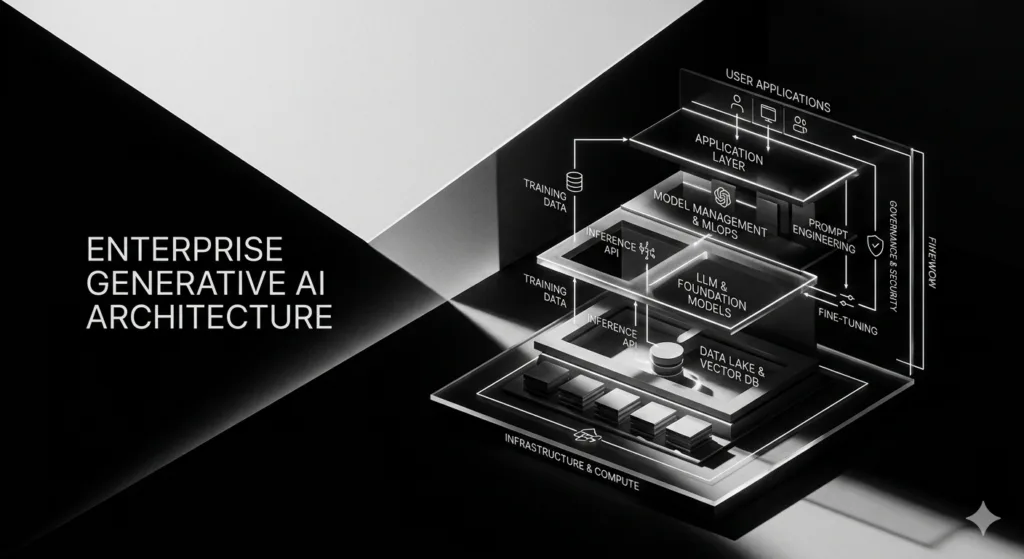
Most definitions of enterprise generative AI architecture incorrectly focus on model selection, API integration, and prompt engineering. These are components of a system, not an architecture.
An architecture defines relationships between components, how those components evolve independently, and how the system behaves under change or failure.
In practice, enterprise GenAI is a platform. Scalable architecture separates pilots from production by embedding identity, governance, routing, and cost controls across workloads — not as optional features, but as structural properties of the system.
The five layers
Every scalable enterprise GenAI architecture consists of five independent layers:
- Data layer — governed pipelines, unified access, provenance tagging at the record level, and sovereignty-compliant storage. The foundational dependency for all other layers.
- Model layer — an abstraction that decouples workflows from specific LLM implementations, enabling model substitution without downstream disruption.
- Orchestration layer — runtime coordination of multi-agent workflows, task routing, shared state management, HITL gating, kill-switch controls, and enforcement of agentic security boundaries.
- Application layer — business-facing interfaces that expose GenAI capabilities, built on shared governed components rather than one-off implementations.
- Governance and LLMOps layer — versioned prompts, retrieval policies, drift monitoring, regression testing across models, cost attribution per workflow, and real-time audit trails.
Independence between layers is the defining requirement: each must be deployable, upgradeable, and testable without destabilizing the others.
3. The Five-Layer Architecture: Legacy vs. Scalable
The comparison below maps each layer from legacy implementation to scalable architecture patterns, along with the failure mode that emerges when underbuilt.
| Layer | Legacy State | Scalable Architecture | Failure Mode |
| Data | Siloed, inconsistent, no provenance | Governed pipelines, MCP access | Hallucination amplification |
| Model | Hardcoded single LLM | Model abstraction layer | Vendor lock-in |
| Orchestration | Manual coordination | Agent runtime + HITL + controls | Loss of governance boundary |
| Application | Custom per use case | Composable shared interfaces | Fragmented systems |
| Governance | Manual audits | Real-time LLMOps | Production compliance failures |
Every failure mode listed is a documented pattern in enterprise AI programs in 2026, not a theoretical concern. The architectural choices in the scalable column are what prevent them.
4. How AI Is Transforming Enterprise Architecture
AI in enterprise architecture has two distinct meanings in 2026.
AI as a subject of enterprise architecture
This refers to AI systems as infrastructure that enterprise architects must design and govern. GenAI workloads introduce continuous model evolution, runtime decisioning, agentic workflows that cross system boundaries, and LLMOps requirements closer to software engineering than traditional system integration.
74% of enterprise architects report that AI has already changed how architecture decisions are made (StackAI, 2026). EA practice is shifting from static documentation cycles to continuous infrastructure governance, because systems are now adaptive rather than static.
AI for enterprise architecture — the practice accelerates
AI is also becoming a design tool for enterprise architecture itself. Architects can use GenAI systems to generate architecture patterns, simulate system behavior under different loads, evaluate trade-offs, and produce documentation aligned with implementation.
Constraints such as compliance requirements, throughput targets, integration complexity, and cost ceilings can be used as inputs to generate and evaluate architecture options before deployment.
This does not replace architectural judgment; it compresses iteration cycles and increases the number of validated design options before production commitment.
The governance shift
The most significant impact of AI-driven enterprise architecture is governance transformation. When AI systems operate at runtime speed — routing workflows, modifying configurations, accessing regulated data — annual architecture reviews and static documentation become insufficient.
Governance must shift into continuous enforcement: architectural decisions embedded into runtime controls rather than stored in documents that are periodically reviewed.
5. The Five Most Common Enterprise GenAI Architecture Failure Modes
Most enterprise GenAI architecture failures are not novel. They follow predictable patterns that appear when the five-layer framework is underbuilt. Understanding them in advance is the most efficient form of architectural risk management.
1. Model lock-in
Designing workflows directly against specific model APIs rather than against an abstraction layer. When the model is superseded, repriced, or deprioritized by the vendor, every workflow built on that API must be rebuilt. The fix is model abstraction from day one: workflow logic written against standardized interfaces that route to specific models, not directly to provider endpoints.
2. Governance retrofitted, not built in
Deploying GenAI workflows without embedded audit trails, cost attribution, or compliance controls — then attempting to add governance when regulatory review arrives. Retrofitted governance consistently produces evidence that auditors treat as less credible than evidence generated at execution time, and it costs more than proactive architectural investment in every case that has been formally studied.
3. Data layer underinvestment
Deploying orchestration and model layers on top of fragmented, unstructured, or inconsistently governed data. As established in Blog 13 of this series: agents running on dirty data do not produce hedged outputs — they produce confident wrong outputs at automation speed. The data layer is the first architectural investment, not a feed that can be addressed later.
4. Monolithic design
Building GenAI capability as a single integrated system rather than as independent modular layers. Monolithic architectures cannot scale selectively: every change requires full system testing and validation, upgrade timelines extend as the system grows, and the architecture progressively resists the evolution that model and regulatory environments will demand.
5. Prompt engineering
Using prompt-level guardrails as the primary defense against data leakage, unauthorized access, or policy violations. Prompt engineering is appropriate for behavioral guidance. It is not appropriate as the primary security and compliance mechanism. These require architectural controls at the infrastructure layer — semantic security at execution time, access enforcement at the data layer, and kill-switch controls at the orchestration layer.
6. Designing for Scale: Five Architectural Principles
The framework for scalable enterprise AI architecture is built on five principles. Each one addresses a specific failure mode from Section V and corresponds to a specific layer in the five-layer stack.
- Model agnosticism from day one.
Abstract the model layer before it needs to change, not after. Design prompt interfaces, data connectors, and orchestration logic against standardized interfaces. The model routing configuration updates when a better model becomes available. The workflows do not. - Governance embedded across every layer.
Every layer generates governance evidence at execution time: the data layer produces access logs, the model layer logs version and configuration state, the orchestration layer logs agent decisions and costs, and the application layer logs user interactions. Governance is a cross-cutting architectural property, not a dedicated layer. - Data foundation as the architectural prerequisite.
Build the governed data layer before deploying agents at scale. Structured, provenance-tagged, sovereignty-compliant data accessible via MCP is the precondition for every other layer performing reliably. Invest in this layer disproportionately relative to its organizational visibility. - Composable, modular layer independence.
Design each layer to be independently deployable, upgradeable, and testable. The organization can upgrade the model layer without touching data pipelines, add new orchestration patterns without modifying application interfaces, and tighten governance controls without disrupting running workflows. - LLMOps as a production discipline.
Versioned prompts, retrieval policies with defined update cadences, regression testing across model versions, drift monitoring with automated alerts, and rollback procedures for failed deployments. These are production engineering requirements for any GenAI system running at enterprise scale — not future-state aspirations.
7. How Beam Data AI Hub Provides the Governed Platform Layer
Every enterprise implementing a scalable generative AI architecture eventually reaches the same question: which platform can operationalize all five architectural layers without requiring the organization to build and maintain the entire control plane itself?
AI Hub by Beam Data is designed to solve that challenge. Rather than governing one layer while relying on custom integrations for the rest, AI Hub provides a single governed platform that spans data, models, orchestration, applications, and LLMOps. Governance, observability, and compliance are built into the architecture rather than added after deployment.
Model Abstraction Built In
Workflows developed on AI Hub are written against a model abstraction layer instead of being tied to specific LLM providers. As the model landscape evolves, organizations can change routing configurations without rebuilding workflows. This approach preserves flexibility, reduces migration costs, and protects enterprise AI investments from rapid model turnover.
Governed Data Foundation Across All Workloads
AI Hub provides governed data pipelines, MCP-native agent access, provenance tracking, and sovereignty controls from a single foundation layer. Every agent operates from the same trusted source of truth, reducing the risk of fragmented context, inconsistent outputs, and hallucination amplification. Governance is enforced at the data layer rather than relying on application-level controls.
LLMOps as a Native Capability
Versioned prompt management, drift monitoring, workflow-level cost attribution, regression testing, and compliance reporting are integrated directly into the platform. Organizations can begin operating with enterprise-grade LLMOps capabilities from day one instead of building custom tooling after deployment.
Industry-Specific Architecture Acceleration
For Manufacturing, Finance, and EdTech organizations, AI Hub includes pre-built agent templates, domain-specific data models, and governance frameworks aligned with industry requirements. This accelerates deployment by reducing the amount of custom architecture, compliance mapping, and prompt engineering required to reach production.
AI Hub by Beam Data provides the governed platform layer that modern enterprise GenAI programs require: model-agnostic, data-governed, orchestration-controlled, and LLMOps-ready across on-premise, private VPC, and cloud environments.
8. Solidify your AI Architecture with Beam Data
Access to foundation models is no longer a competitive advantage. As model capabilities become increasingly accessible, long-term differentiation comes from architectural maturity: the ability to build AI systems that are modular, governed, scalable, and adaptable as technology and regulations evolve.
Organizations that establish a strong architectural foundation today will be able to adopt new models, scale new use cases, and respond to regulatory change far more effectively than those forced to retrofit governance and infrastructure later.
AI Hub by Beam Data brings the five layers of enterprise GenAI architecture together into a single governed platform, eliminating the complexity of stitching together multiple point solutions. By combining model abstraction, governed data access, orchestration controls, and integrated LLMOps, it gives organizations a foundation that is scalable, compliant, and adaptable as AI technologies evolve. For enterprises looking to move beyond pilots and build production-ready AI systems, AI Hub provides the architectural framework needed to deploy, govern, and scale AI with confidence.
Ready to evaluate your enterprise AI architecture? Schedule a 30-minute architecture review with the Beam Data team or request a personalized AI Hub demonstration to see how a governed, scalable GenAI platform can accelerate your path from pilot to production.
Author
By the Beam Data Team | Reviewed by Maliha, Content Editor
Frequently Asked Questions
- What is enterprise generative AI architecture?
Enterprise generative AI architecture is the framework that connects AI models, data, applications, orchestration, and governance into a scalable system. It helps organizations deploy AI reliably, securely, and compliantly across the enterprise.
- What are the main components of a scalable enterprise AI architecture?
A scalable AI architecture includes a governed data layer, model abstraction layer, orchestration runtime, application layer, and governance/LLMOps layer. These layers should evolve independently without disrupting the entire system.
- How is AI changing enterprise architecture?
AI is changing enterprise architecture by introducing new governance, monitoring, and operational requirements. It is also helping architects design systems faster through automation, simulation, and decision support.
- What are the biggest challenges in enterprise generative AI architecture?
Common challenges include model lock-in, poor data quality, weak governance, monolithic system design, and overreliance on prompt engineering. These issues can limit scalability, security, and long-term flexibility.
- What should regulated industries consider when building AI architecture?
Regulated industries must embed compliance, security, auditability, and data governance into every layer of the architecture. Requirements such as GDPR, DORA, and HIPAA should be addressed from the start.
- How does Beam Data AI Hub support enterprise generative AI architecture?
Beam Data AI Hub brings together governed data pipelines, model abstraction, orchestration, sovereignty controls, and integrated LLMOps in a single platform. This enables secure, scalable, and model-agnostic AI deployments across environments.
References
- Systango and McKinsey & Company. Enterprise AI Architecture and Scaling Constraints in Production Systems. Feb. 2026.
- Gartner. “Gartner Says More Than 80% of Enterprises Will Have Used Generative AI APIs or Deployed Generative AI-Enabled Applications by 2026.” 11 Oct. 2023, https://www.gartner.com/en/newsroom/press-releases/2023-10-11-gartner-says-more-than-80-percent-of-enterprises-will-have-used-generative-ai-apis-or-deployed-generative-ai-enabled-applications-by-2026. Accessed 12 June 2026.
- StackAI. State of Enterprise Architecture: AI-Driven Decision Making Report. Mar. 2026.
- TechBlocks. “Generative AI Architecture for Enterprises: Models, Layers, and Production Workflows.” TechBlocks, Mar. 2026, https://tblocks.com/articles/generative-ai-architecture/. Accessed 12 June 2026.
- Leanware. Agentic Systems in Production: Design and Operational Risks. Jan. 2026.
- Techment. Enterprise AI Adoption and Infrastructure Readiness Report. Dec. 2025.
- Stanford HAI AI Index 2024 Report. AI Index Report 2024. Stanford Institute for Human-Centered AI, 2024. Accessed 12 June 2026.