
Key Takeaways
- Only 18% of organizations rigorously measure AI ROI, and 40% are not sure what factors constitute AI success. Most enterprises are flying blind on the financial case for AI investment.
- Verified enterprise AI implementations achieve 333% ROI over 3 years with payback periods under 6 months, when run on infrastructure built to measure, govern, and reuse AI value.
- An AI Operating Layer converts the variable, compounding costs of a fragmented AI stack into a single governed platform — generating ROI at every layer: implementation, engineering time, compliance overhead, and reuse value.
- This blog gives you the complete ROI framework: the hidden costs you are already paying, the four value drivers that build the business case, a worked 3-year TCO model, and the exact language to bring to your CFO.
1. Why Most Enterprise AI ROI Calculations Are Wrong
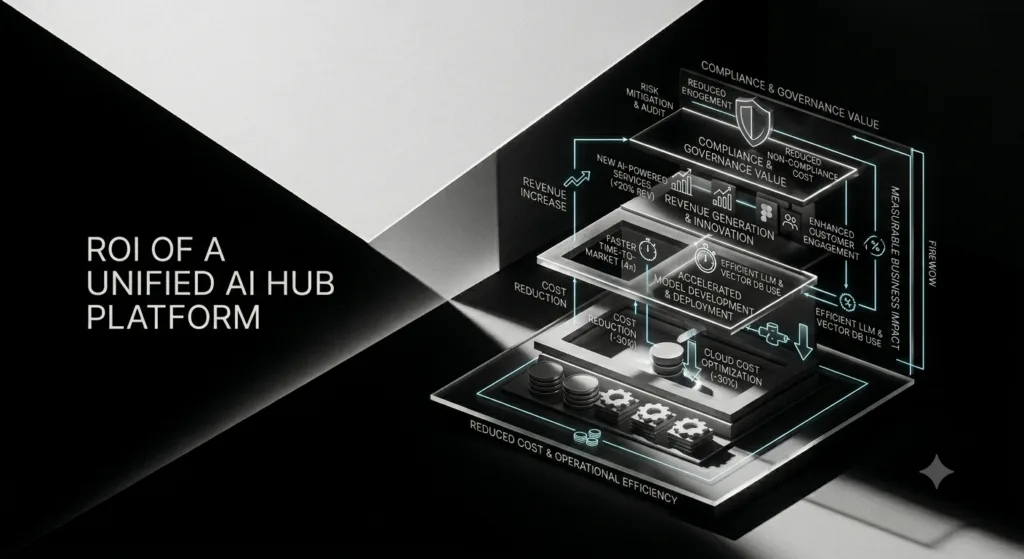
Only 18% of organizations collect ROI metrics for AI with any rigor, and 40% admit they are not sure what factors constitute AI success (WRITER, March 2026). The organizations in that 18% are frequently undercounting. They track direct productivity gains — hours saved, tickets resolved — while missing the infrastructure debt, integration overhead, compliance risk, and opportunity cost that fragmented AI stacks accumulate silently, outside the line items anyone is watching.
The consequence is stark: only 5% of enterprises see real AI returns (Master of Code, April 2026). The gap is not model capability — every organization in that 95% has access to the same frontier models as the 5% generating real returns. The gap is infrastructure and measurement.
Enterprises that cannot attribute AI cost by workflow, track governance overhead, or measure the compounding value of reusable AI assets are not failing at AI. They are failing at AI accounting.
This blog is the complete ROI framework for justifying investment in a unified AI platform. It is built for the reader who needs to take a business case to a CFO, a board, or a procurement committee — not a technical audience that needs convincing AI works, but a financial audience that needs the numbers to hold up under scrutiny.
2. The Hidden Costs of Fragmented AI: What You’re Already Paying
Before calculating the ROI of a unified platform, it is necessary to establish the true cost of the fragmented alternative — because most organizations have never added it up.
The integration tax
Every standalone AI deployment requires custom integration to enterprise data sources, security systems, and governance frameworks. StackAI’s February 2026 ROI framework estimates Year 0 implementation cost at $250,000 for a single enterprise AI workflow — integration, security review, workflow design, evaluation harness, and team enablement — with Year 1 run cost of $220,000 in platform, usage, monitoring, and maintenance spend. That is $470,000 for one workflow. The average enterprise is running dozens of overlapping AI initiatives across departments.
Engineering maintenance overhead
Organizations relying on custom-built AI orchestration layers spend up to 60% of AI engineering time on infrastructure maintenance rather than workflow development (Elevate, 2026). At an average fully-loaded cost of $150,000 per AI engineer, a five-person AI team spending 60% of its time on maintenance represents $450,000 per year in misallocated engineering capacity — before a single workflow has been improved.
Compliance and audit overhead
Without centralized audit trails and automated governance, compliance review for each AI system requires manual evidence gathering. Financial services organizations report 3 to 6 weeks of manual audit preparation per AI system per regulatory review cycle. At enterprise scale, with multiple systems and multiple annual review cycles, this overhead becomes a material recurring cost that a unified governance layer eliminates by generating audit evidence at execution time rather than assembling it after the fact.
Model lock-in switching costs
Organizations without model abstraction layers face re-engineering costs every time the model landscape shifts. With new model generations arriving every six to twelve months, lock-in to specific LLM APIs creates recurring, unbudgeted engineering spend that a model-agnostic platform converts into a one-time configuration update.
Shadow AI risk cost
Unmanaged AI deployed outside IT governance creates compliance exposure that actuarializes as risk cost — fines, breach remediation, regulatory censure, reputational damage. EU AI Act penalties of up to 35 million euros or 7% of global turnover for high-risk system violations make shadow AI a quantifiable financial risk, not just a governance concern, and it belongs in any honest cost baseline.
3. The Four ROI Value Drivers of a Unified AI Platform
With the hidden cost baseline established, the second half of the equation is value. Four drivers consistently appear across verified enterprise AI ROI studies.
Driver 1: Workflow automation efficiency
The most measurable driver. 82% of enterprise AI value comes from workflow automation and process efficiency — not model intelligence in isolation (IBM, 2026). Organizations automating customer service report response times 65% faster and ticket resolution twice as fast, with operating cost reductions near 30% for the functions automated. This is hard, directly attributable ROI.
Driver 2: Engineering and infrastructure cost reduction
A unified platform converts recurring integration, maintenance, and rebuild costs into a single managed contract. Organizations with unified AI governance platforms experience 23% fewer AI-related incidents and bring new AI capabilities to production 31% faster (Elevate, 2026). The speed advantage carries direct financial value — faster production means faster revenue attribution and faster realization of cost-avoidance gains.
Driver 3: Risk and compliance cost avoidance
Expected value avoided through consistent governance and audit readiness. StackAI’s ROI framework benchmarks this at approximately $80,000 per year for a mid-market enterprise through reduced compliance incidents and faster audit response. For regulated industries at enterprise scale, this figure is materially higher — the cost of a single regulatory finding, including direct fine, remediation, and management time, typically exceeds a full year of platform cost.
Driver 4: Strategic optionality and reuse value
The hardest driver to quantify and among the most significant over time. A unified platform creates reusable AI assets — standardized agent templates, governed data connections, shared orchestration patterns — that amortize across every subsequent deployment. The first workflow on a unified platform costs more to stand up than a point-tool equivalent. The fifth workflow costs a fraction of it, because the infrastructure investment has already been made. This compounding reuse is the structural financial case for platform investment over best-of-breed assembly.
4. The ROI Calculation Framework: A Worked Example
The table below models a representative 3-year total cost of ownership comparison between a fragmented point-solution AI stack (3 production workflows) and a unified AI platform covering the same scope.
| Cost Category | Fragmented Point-Solution Stack | Unified AI Operating Layer |
| Year 0 implementation | $750,000 (3 workflows, custom integration) | $400,000 (unified onboarding, all workflows) |
| Annual run cost (Y1-Y3) | $440,000/yr (licenses + integration + compliance) | $180,000/yr (single platform contract) |
| Engineering maintenance | 60% of AI engineering time on infrastructure | Minimal – governance is native to the platform |
| Compliance audit prep | 3-6 weeks per system per review cycle | Hours – audit trails generated at execution time |
| Model upgrade cost | Full workflow rebuild per model change | Configuration update only – model-agnostic routing |
| 3-year total cost of ownership | $2.07M | $940,000 |
The platform cost advantage — $1.13 million over three years — exists before any of the four value drivers from Section 3 are applied. Layer in workflow automation efficiency, engineering reallocation, and compliance cost avoidance, and the combined annual value for a representative 500-employee enterprise running three automated workflows reaches approximately $1.07 million against a Year 1 platform run cost of $180,000 — a first-year ROI of roughly 494%. WRITER’s verified benchmark across enterprise customer implementations shows comparable results at scale: $15.63 million in 3-year benefits against $3.61 million invested, generating $12.02 million NPV, 333% ROI, and payback under 6 months.
The conservative framing that survives CFO scrutiny: include labor savings at a 35% realization rate (not 100% — the remainder shows up as quality and responsiveness gains, not headcount reduction), include compliance cost avoidance as expected value, and exclude revenue uplift from the base case unless directly attributable. Model revenue separately as conservatively quantified upside.
5. ROI by Industry: Where the Numbers Are Strongest
Industry context changes which value drivers dominate the ROI calculation.
1.Financial services
Financial Services Agentic Solutions like AI-powered customer service and compliance automation deliver 65% faster response times and roughly 30% operating cost reduction. Compliance audit preparation drops from weeks to hours. The compliance cost avoidance driver is strongest here — DORA, GDPR, and MiFID II audit exposure makes governance infrastructure directly valuable to the CFO, not just to risk and compliance teams.
2.Healthcare
Clinical documentation automation reduces documentation time per patient encounter by 40 to 60%. Prior authorization processing time falls by more than half. ROI here is partly financial and partly capacity-based — freed clinical time has direct patient outcome value that is harder to monetize but real.
3.Manufacturing
Predictive maintenance AI delivers a 62% cost advantage over cloud-based equivalents at steady-state volume (Dell/ESG). Supply chain exception management automation reduces manual intervention by 30 to 50% per workflow, with direct cost-of-quality implications from improved defect detection.
6. Building the Internal Business Case: A 4-Step Framework
- Baseline your current AI infrastructure cost. Total spend across every AI tool, platform, and API. Engineering time allocated to integration and maintenance at fully-loaded rates. Compliance overhead per AI system per year. Estimated shadow AI risk cost. Most organizations discover their true AI infrastructure cost is two to three times what is visible in vendor invoices alone.
- Identify your top three orchestration-ready workflows. High volume, multiple data sources, currently requiring human coordination between steps, and measurable error rate or processing cost. Automated claims processing, supply chain exception handling, and tier-1 customer service resolution are common high-ROI starting points. Quantify current cost per unit for each before modeling AI impact.
- Model the 3-year TCO comparison. Build the comparison shown in Section 4 for your own workflow portfolio: unified platform cost versus point-solution assembly cost. Apply the four value drivers conservatively, using a 35% labor realization rate and excluding unattributed revenue uplift from the base case.
- Present platform versus point-tool as a risk-adjusted decision. The strongest CFO argument is predictability: a unified platform converts variable, uncertain integration and compliance costs into a predictable contract. The risk-adjusted value of eliminating tail risk — a regulatory finding, a surprise model rebuild, an ungoverned AI sprawl incident — is frequently the most persuasive line in the business case.
7. Why the AI Operating Layer Multiplies Platform ROI
An AI Operating Layer governs the full stack — data, model, orchestration, governance, and LLMOps — from a single control plane. This architecture generates ROI at every layer simultaneously: fewer integration points reduce Year 0 implementation cost, model abstraction eliminates rebuild cycles, centralized audit trails eliminate compliance overhead, and reusable agent templates reduce the marginal cost of every new workflow.
The compounding reuse advantage
The most distinctive ROI property of a unified AI Operating Layer is compounding reuse. Every governed data connection, agent template, and orchestration pattern built on AI Hub is available to every subsequent deployment. The tenth workflow on AI Hub costs a fraction of what the first workflow on a point-tool stack would cost, because the infrastructure investment has already been made once. This compounding is the mechanism behind the gap between platform ROI and point-tool ROI as deployment scope grows.
Cost predictability as a financial benefit
AI Hub converts the variable, uncertain cost profile of a fragmented AI stack into a predictable platform contract. That predictability carries direct financial value: it reduces the working capital required for AI infrastructure, simplifies annual budgeting, and eliminates the tail-risk costs — regulatory findings, emergency rebuild cycles, shadow AI remediation — that make fragmented AI stacks financially unpredictable in ways that rarely show up until they already have.
Industry-specific ROI acceleration
For Manufacturing, Finance, and EdTech enterprises, AI Hub’s verticalized intelligence reduces implementation time and cost for industry-specific deployments. Pre-built agent templates and domain-specific governance rules eliminate the discovery and configuration work that typically represents 40 to 60% of Year 0 implementation cost. The ROI clock starts earlier, and payback shortens accordingly.
8. ROI Is an Infrastructure Question, Not a Model Question
The enterprises generating 333% ROI on AI investment are not using more advanced models than the enterprises seeing minimal returns. They are operating AI on infrastructure that can measure, attribute, govern, and reuse value — a unified AI Operating Layer that converts AI activity into accountable, auditable, compounding business outcomes.
Only 18% of organizations currently measure AI ROI with any rigor. The organizations that build that measurement capability — through a unified platform with centralized cost attribution, audit trails, and workflow performance metrics — will have the evidence base to accelerate investment, justify scale, and make procurement decisions that competitors operating on fragmented infrastructure simply cannot match.
Measure your AI ROI with Beam Data. Build a CFO-ready 3-year TCO model tailored to your workflows and costs. Schedule a Beam Data business case review and see where your AI spend is actually going.
By the Beam Data Team | Reviewed by Maliha, Content Editor
Frequently Asked Questions
1. How do you calculate the ROI of an enterprise AI platform?
Enterprise AI ROI compares total cost of ownership against measurable business value. The most effective models evaluate automation gains, infrastructure savings, compliance improvements, and the long-term value of reusable AI assets.
2.What are the four main value drivers in an enterprise AI ROI model?
The four primary drivers are workflow automation, engineering and infrastructure savings, compliance and risk reduction, and AI asset reuse. Together, they provide a more complete measure of AI value than productivity metrics alone.
3.Why do most enterprise AI ROI calculations undercount real returns?
Many organizations focus only on productivity gains while overlooking infrastructure, governance, maintenance, and compliance impacts. This often understates both the cost of fragmented AI environments and the value of a unified platform.
4.What is a realistic payback period for a unified AI hub platform?
Many enterprise AI platforms achieve payback within the first year, with high-impact use cases often delivering value in under six months. Results vary based on deployment scope, implementation maturity, and workflow complexity.
5.What should regulated industries include in an enterprise AI ROI calculation?
Regulated organizations should include governance, compliance, audit readiness, and risk reduction alongside productivity gains. In sectors like finance, healthcare, and manufacturing, avoiding compliance costs and reducing audit effort can be as valuable as operational efficiency.
6.How do you present an enterprise AI ROI business case to the board?
Focus on total business impact rather than technical capabilities. Compare the three-year cost of fragmented AI against a unified platform, quantify operational savings and risk reduction, and highlight governance, scalability, and predictable long-term ROI that supports strategic growth.
7.How does Beam Data AI Hub generate ROI across the enterprise AI stack?
Beam Data AI Hub acts as a unified AI Operating Layer that governs data, models, orchestration, and compliance from a single platform. This reduces infrastructure complexity, accelerates deployment, lowers maintenance costs, and increases the reuse of AI assets across the enterprise.
References
Dell / Enterprise Strategy Group (ESG). Economic Value Validation: Analyzing the Operational and Financial Benefits of Dell AI Infrastructure solutions. ESG Research, 2025. www.dell.com/en-us/dt/corporate/newsroom/announcements/detailpage.press-releases~usa~2026~03~dell-ai-factory-with-nvidia-delivers-proven-path-to-enterprise-ai-roi.htm.
Deloitte. The State of Generative AI in the Enterprise: Now Decides Next. Deloitte AI Institute, 2026. www.deloitte.com/us/en/pages/technology/articles/state-of-generative-ai-in-enterprise.html.
Elevate. Enterprise AI Infrastructure & Maintenance Overhead Report. Elevate Research, 2026.https://www.elevate.ai/blog/elevate-research-findings-ai-and-modernization-trends.
IBM. Global AI Adoption Index 2026. IBM Institute for Business Value, 2026. www.ibm.com/reports/global-ai-adoption-index.
Master of Code Global. The Real State of Enterprise AI Returns. Master of Code, Apr. 2026. www.masterofcode.com/blog/the-real-state-of-enterprise-ai-returns.
StackAI. Enterprise AI Operational Deployment & ROI Framework. Digital Applied / StackAI, Feb. 2026. www.digitalapplied.com/blog/ai-agent-roi-calculator-enterprise-business-case.
WRITER. The Enterprise AI ROI and Business Case Benchmark Study. WRITER, Mar. 2026. www.writer.com/resources/enterprise-ai-roi-benchmark-study.